
In the modern digital ecosystem, speed is no longer a luxury; it is a fundamental requirement for user experience, operational efficiency, and competitive advantage. As applications evolve to support real-time analytics, augmented reality, autonomous vehicles, and high-frequency trading, the traditional centralized cloud architecture faces a critical bottleneck: latency. The physical distance between the end-user and the central data center introduces delays that can degrade performance, causing lag in video streaming, stuttering in online gaming, or delayed responses in industrial control systems. This is where edge computing emerges as a transformative solution. By shifting computation closer to the data source, edge computing drastically reduces network round-trip time, effectively enhancing cloud latency and overall system speed without sacrificing the scalability and storage benefits of the central cloud.
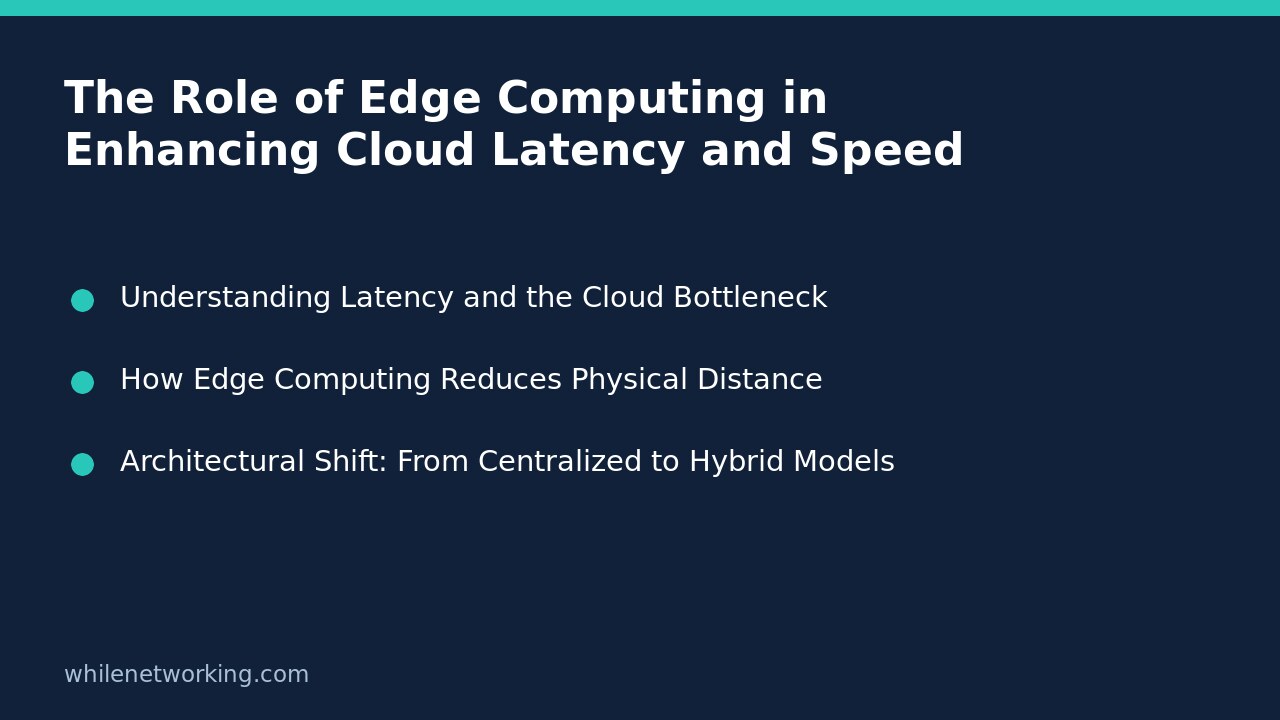
Understanding Latency and the Cloud Bottleneck
To appreciate the impact of edge computing, one must first understand the nature of latency in a centralized cloud environment. Latency is the time delay inherent in a communication network, often caused by the physical distance data must travel. In a traditional “cloud-first” architecture, all processing happens in massive data centers located hundreds or thousands of miles away from the user. When a user requests data, that request travels to the server, processes through complex layers of software, and then sends the response back. This round trip can take anywhere from 50 to 200 milliseconds depending on geographic location and network congestion.
For standard web browsing, this delay is imperceptible. However, for applications requiring real-time interaction—such as remote robotic surgery, self-driving cars avoiding pedestrians, or immersive VR training simulations—a latency of even 100 milliseconds can be catastrophic. The central cloud acts as a single point of failure for speed; if the network path to that specific data center is congested or if the server is overloaded, performance degrades globally for all users in that region.
How Edge Computing Reduces Physical Distance
Edge computing addresses the latency issue by decentralizing the architecture. Instead of sending every packet of data to a central hub for processing, edge nodes perform computation and data analysis closer to where the data is created. These nodes can be located on-premises at an enterprise, within a telecom tower, or in a local internet exchange point.
By moving the compute resources geographically closer to the user, the physical distance data must traverse is minimized. This reduction in distance directly correlates to lower latency because light—and therefore electrical signals—take time to travel through fiber optic cables and copper wires. If an industrial sensor in a factory needs to trigger a safety mechanism instantly, sending that signal to a cloud server in Virginia and back would be too slow. An edge node located within the same factory building can process that signal in microseconds, ensuring immediate response times while still syncing with the central cloud for long-term storage and historical analysis.
Architectural Shift: From Centralized to Hybrid Models
The integration of edge computing does not replace the cloud; it creates a hybrid architecture where tasks are distributed intelligently based on urgency and data sensitivity. In this model, time-critical operations are handled at the edge, while heavy lifting like machine learning model training, big data warehousing, and long-term archival storage remains in the central cloud.
This separation allows for optimal resource utilization. The edge handles the “now,” ensuring low latency for real-time applications. The core cloud handles the “later,” leveraging its vast compute power for batch processing. This architectural shift requires a rethinking of network design and application logic. Developers must now architect software that can function partially offline or with intermittent connectivity, relying on edge nodes to cache data and execute logic until a connection to the central cloud is restored.
Real-World Application: Autonomous Vehicle Fleets
A compelling example of edge computing enhancing speed is found in autonomous vehicle (AV) fleets. Imagine a convoy of self-driving trucks navigating a highway. Each truck is equipped with cameras, LiDAR sensors, and powerful onboard computers acting as edge nodes. If one truck detects an obstacle, such as a stalled vehicle or debris, it must communicate this to the fleet immediately to prevent a collision.
In a purely cloud-based scenario, Truck A would send sensor data to a central cloud, where an AI model analyzes the threat, determines the braking distance, and sends a command back to Truck B. This process might take 150 milliseconds. In that fraction of a second at 60 mph, both vehicles could travel roughly 26 feet—a dangerous distance.
With edge computing, the decision-making logic resides on the vehicle itself (the edge). The onboard computer processes the sensor data locally and triggers braking or steering adjustments in under 10 milliseconds. Simultaneously, this event is logged to a local edge server at the nearest cellular tower, which aggregates data from nearby vehicles before syncing with the central cloud for fleet-wide learning. This hybrid approach ensures life-saving decisions happen instantly at the edge while maintaining the strategic benefits of centralized data management.
Implementation Checklist for Organizations
Organizations looking to leverage edge computing to reduce latency should follow a structured implementation path:
- Audit Current Workloads: Identify which applications are latency-sensitive. Are there real-time video streams, IoT sensor aggregations, or interactive user interfaces?
- Map Network Topology: Determine the physical locations of data sources and users. Identify potential bottlenecks in your current network infrastructure.
- Select Edge Hardware: Choose edge devices based on compute requirements, power consumption, and environmental durability. Consider containerization technologies like Kubernetes Edge for managing workloads across distributed nodes.
- Redesign Application Logic: Refactor applications to handle local processing. Ensure data synchronization protocols are robust enough to handle intermittent connectivity between edge and core.
- Establish Security Protocols: Since the attack surface expands with more devices, implement strict identity management, encryption for data in transit between edge and cloud, and regular patching schedules for edge nodes.
Common Pitfalls in Edge Deployment
Despite its benefits, rushing into edge computing without a plan can lead to significant issues. A common mistake is attempting to replicate the entire central cloud environment at the edge. Edge devices have limited resources compared to massive data centers; trying to run heavy databases or complex training models on them will result in poor performance and overheating. Another error is neglecting security. An expanded network with numerous entry points requires a zero-trust security model, as compromised edge devices can serve as pivots for larger attacks. Furthermore, organizations often underestimate the complexity of data synchronization. Without a clear strategy for how data moves from the edge to the cloud, systems can become inconsistent, leading to data silos and conflicting information between the local view and the global view.
Conclusion
The role of edge computing in enhancing cloud latency and speed is not merely an optimization; it is a necessary evolution of digital infrastructure. By bringing computation closer to the source of data, organizations can overcome the physical limitations of centralized networks, enabling real-time responsiveness that was previously impossible. While the transition requires careful architectural planning, security considerations, and workload redistribution, the payoff is a resilient, high-speed digital ecosystem capable of supporting the most demanding applications of tomorrow. As 5G networks expand and IoT devices proliferate, the synergy between edge and cloud will define the next generation of internet performance, ensuring that data moves as fast as reality itself.