
In the rapidly evolving landscape of cloud computing, developers and architects are constantly seeking ways to reduce operational overhead while maximizing scalability. One of the most transformative paradigms in this space is serverless architecture. Despite the name, “serverless” does not mean a lack of servers; rather, it refers to an abstraction model where the cloud provider automatically manages the infrastructure required to run your code. This approach allows teams to focus entirely on writing application logic without worrying about provisioning, patching, or scaling physical or virtual machines. For businesses aiming to build scalable applications with less code, understanding the mechanics and strategic implementation of serverless is no longer optional—it is essential.
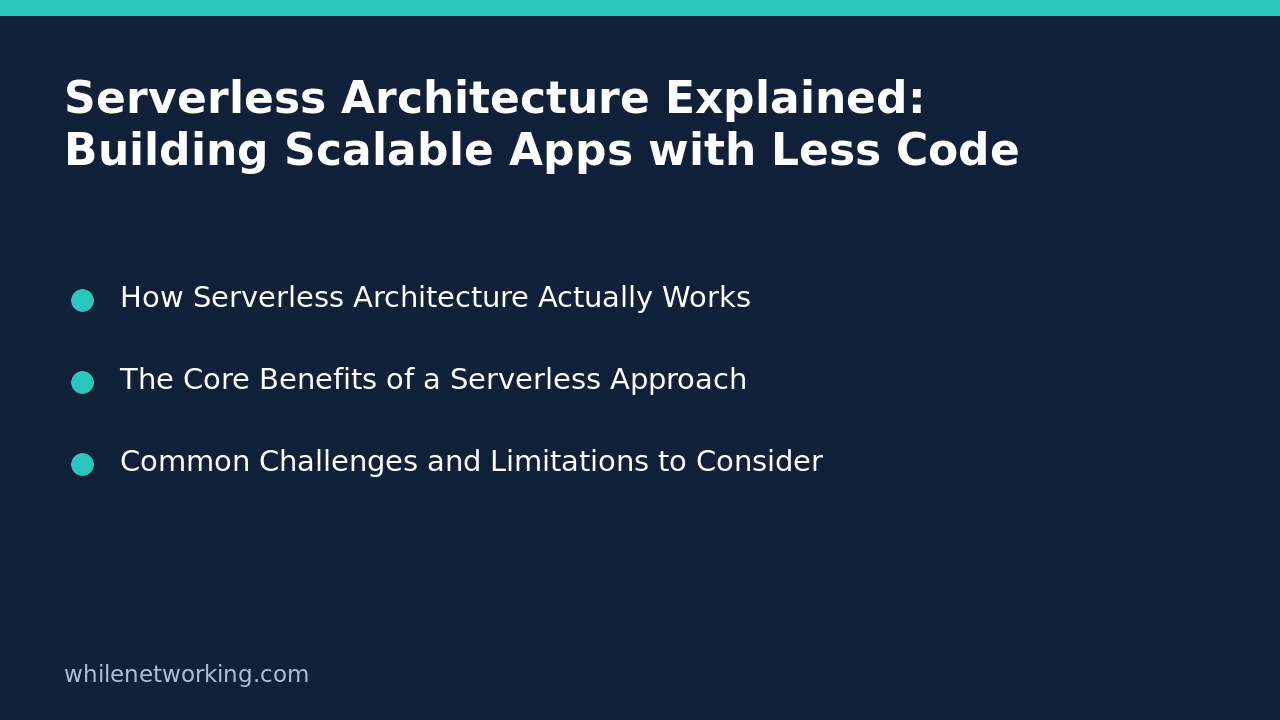
How Serverless Architecture Actually Works
The fundamental concept behind serverless architecture relies on Function-as-a-Service (FaaS) models, though it often encompasses broader Platform-as-a-Service (PaaS) offerings like AWS Lambda, Azure Functions, or Google Cloud Functions. When you deploy code to a serverless platform, the provider breaks your application into discrete functions. Each function is triggered by specific events, such as an HTTP request, a file upload to cloud storage, or a message arriving in a queue.
Upon triggering, the cloud provider instantiates a container to run your code for that specific duration. Once the execution finishes, the container is destroyed. This on-demand scaling means you only pay for the compute time your code actually consumes, measured in milliseconds. There is no idle cost; if your application sits dormant for weeks, your bill remains zero. This differs significantly from traditional virtual machine (VM) models where you pay for reserved capacity regardless of utilization.
The Core Benefits of a Serverless Approach
Adopting serverless architecture offers distinct advantages that directly impact development speed and cost efficiency. The primary benefit is the reduction in operational burden. In a traditional infrastructure setup, DevOps teams spend significant time managing operating system updates, patching security vulnerabilities, and handling capacity planning. With serverless, these tasks are offloaded to the cloud provider. This allows development teams to iterate faster, as they can deploy new features without undergoing lengthy infrastructure provisioning processes.
Scalability is another critical advantage. In a monolithic or VM-based architecture, scaling often requires manual intervention or pre-configured auto-scaling rules that might not handle sudden traffic spikes effectively. Serverless platforms automatically scale from zero to thousands of concurrent executions within seconds. If your application experiences a viral moment on social media, the infrastructure scales instantly to meet the demand without any code changes required on your part.
Furthermore, serverless encourages a modular development style known as “micro-functions.” Instead of maintaining one large, monolithic codebase, developers create small, single-purpose functions that handle specific tasks. This modularity makes the code easier to test, debug, and maintain. If one function fails or needs updating, it does not necessarily bring down the entire application, thereby improving overall system resilience.
Common Challenges and Limitations to Consider
While the benefits are substantial, serverless architecture is not a silver bullet for every scenario. One of the most significant challenges is “cold starts.” A cold start occurs when no instances of your function have run recently, forcing the cloud provider to spin up a new environment from scratch before executing your code. This can introduce latency ranging from hundreds of milliseconds to several seconds, which can be detrimental to real-time applications or user experiences sensitive to delay.
Vendor lock-up is another consideration. Since serverless platforms are proprietary services tied to specific cloud providers, migrating your application from AWS Lambda to Azure Functions or Google Cloud Run often requires rewriting parts of the codebase and adjusting deployment pipelines. While standard runtimes like Python, Node.js, and Go are supported across vendors, custom runtimes or specialized dependencies can create friction during migration.
Cost structures can also be deceptive for certain workloads. While you save on idle costs, high-frequency, short-duration executions might incur higher total costs compared to a long-running VM for specific batch processing tasks. Additionally, debugging in a serverless environment can be more complex because logs are distributed across multiple event chains and container instances, making it harder to trace a single user’s journey through the application without specialized observability tools.
Real-World Example: Building an Image Processing Pipeline
To illustrate the practical application of serverless architecture, consider a digital photography studio that needs to process thousands of images uploaded by clients daily. In a traditional setup, this might involve maintaining a fleet of servers running image processing software 24/7, even when traffic is low.
Using a serverless approach, the workflow would look like this: A client uploads an image to an object storage bucket (like Amazon S3). This upload event triggers a function that automatically initiates image processing. The function runs code to resize the image for web display, apply watermarks, and convert formats for mobile devices. Once complete, the processed images are stored in a different bucket or sent to a CDN.
If the studio receives 10 uploads an hour, perhaps two containers spin up and down. If they receive 10,000 uploads during a holiday sale, thousands of containers scale out instantly to handle the load. When the rush ends, all containers shut down immediately. The developer only writes the code for the resizing logic; they do not write code for network management, storage mounting, or OS maintenance. This specific example demonstrates how serverless transforms a complex infrastructure challenge into a simple event-driven workflow.
Best Practices for Implementing Serverless Applications
To maximize the potential of serverless architecture while mitigating its risks, developers should adhere to several best practices. First, optimize your code size and execution time. Since you are billed by duration, keeping your dependencies minimal and your logic efficient reduces costs and minimizes cold start latency. Use layer caching for common libraries when possible.
Second, implement robust error handling and retries. In distributed serverless systems, individual function calls can fail due to transient network issues. Design your architecture to handle failures gracefully, perhaps by sending failed requests back to a queue for retry later rather than failing the entire transaction immediately.
Third, embrace observability from day one. Standard logging tools often struggle with serverless environments because logs are ephemeral and tied to specific request IDs. Invest in cloud-native monitoring solutions that can trace requests across multiple functions and services. This ensures you can quickly identify bottlenecks or security anomalies.
Finally, design for statelessness. Serverless functions should not store state internally; instead, rely on external managed databases or caches like DynamoDB or Redis. If a function is terminated after execution, any internal memory is lost. Ensuring your application logic does not depend on local state prevents data loss and ensures consistent behavior across scaled instances.
Conclusion: When to Choose Serverless
Serverless architecture represents a powerful shift in how scalable applications are built, offering unmatched flexibility for event-driven workloads. It reduces the burden of infrastructure management, accelerates development cycles, and provides automatic scaling capabilities that traditional architectures struggle to match. However, it is not suitable for every application. Real-time gaming, long-running batch jobs with predictable durations, or applications requiring low-latency responses where cold starts are unacceptable may still benefit from traditional containerized or VM-based approaches.
The decision to adopt serverless should be based on a careful analysis of your workload patterns, latency requirements, and team expertise. By understanding the trade-offs between cost, performance, and operational complexity, organizations can leverage serverless tools to build robust, scalable applications without getting bogged down in infrastructure management. As cloud technologies continue to mature, hybrid approaches combining serverless functions with managed databases and APIs will likely become the standard for modern application architecture.