
As enterprises migrate critical workloads to public, private, and hybrid cloud environments, the perimeter of traditional network security has dissolved. This shift presents a unique challenge: how to protect data when it resides on infrastructure managed by third-party providers rather than an internal IT team. The answer lies in a paradigm shift from “castle-and-moat” defense to a shared responsibility model, where organizations must actively manage their own identity governance, encryption strategies, and configuration hygiene. Understanding cloud security is no longer optional; it is the foundational requirement for any enterprise seeking to leverage the scalability of modern computing without compromising data integrity or regulatory compliance.
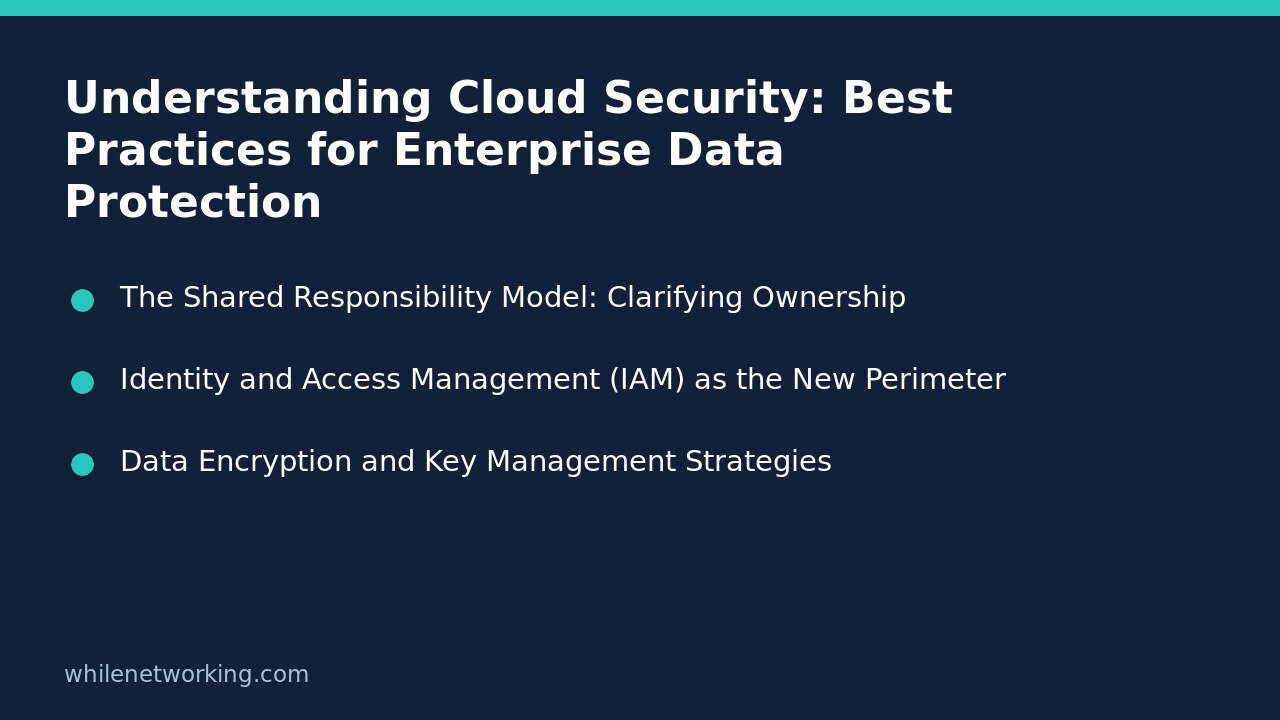
The Shared Responsibility Model: Clarifying Ownership
The cornerstone of cloud security is understanding the shared responsibility model. In this framework, the cloud service provider (CSP) secures the infrastructure—the physical data centers, servers, and networking hardware—while the enterprise client is responsible for securing the data, applications, operating systems, and identity management within that environment. A common misconception among CIOs and security leaders is assuming that purchasing a cloud subscription automatically guarantees full security coverage. In reality, misconfigurations in the customer’s portion of the responsibility account for the vast majority of cloud breaches.
For example, consider an enterprise moving to a major public cloud provider. The provider ensures that their physical servers are locked down against unauthorized physical access and that the hypervisor is patched. However, if the enterprise fails to encrypt its database storage or leaves a security group open to the public internet, the breach occurs within the customer’s sphere of control. To mitigate this risk, organizations must conduct regular audits specifically focused on the layers they own: identity and access management (IAM), data encryption keys, and application-level security configurations.
Identity and Access Management (IAM) as the New Perimeter
With the dissolution of network perimeters, identity has become the new boundary. The principle of least privilege (PoLP) is non-negotiable in a cloud environment. Every user, service account, and application should only possess the minimum permissions necessary to perform their specific function. Over-provisioned access rights create an expansive attack surface; if credentials for a high-privilege account are compromised, attackers gain unrestricted access to the entire cloud tenant.
Implementing robust IAM involves moving away from static passwords toward multi-factor authentication (MFA) and just-in-time (JIT) access. JIT access allows users to request elevated privileges only for the specific duration needed to complete a task, after which those rights are automatically revoked. Furthermore, organizations should leverage Identity Providers (IdP) that support Single Sign-On (SSO) to reduce password fatigue while maintaining strict audit trails. For instance, a developer needing to deploy code to a production environment should not have permanent admin access. Instead, they should authenticate through a temporary token issued via an automated workflow, ensuring that no single individual holds the keys to the kingdom indefinitely.
Data Encryption and Key Management Strategies
Data protection must occur at every stage of its lifecycle: at rest, in transit, and in use. While cloud providers often offer encryption for storage volumes and network traffic, enterprises should consider managing their own encryption keys. This approach, known as Bring Your Own Key (BYOK) or Wrap Your Own Key (WYOK), ensures that even if the cloud provider’s infrastructure is somehow breached, the data remains unreadable without the specific cryptographic keys held by the enterprise.
Encryption in transit is typically handled via Transport Layer Security (TLS) protocols, but configuration errors here are frequent. Organizations must enforce strict TLS version requirements and disable outdated ciphers. For data at rest, utilizing customer-managed keys allows for granular control over key rotation policies. If an organization stores sensitive intellectual property or personally identifiable information (PII), the default encryption settings provided by the cloud vendor may not be sufficient. A best practice is to implement a centralized Key Management Service (KMS) that automates key generation, storage, and rotation schedules, ensuring compliance with standards like FIPS 140-2 without relying on manual intervention.
Configuring Secure Network Architectures
A flat network architecture in the cloud invites lateral movement by attackers who breach one segment to access others. The modern cloud security posture relies on micro-segmentation and zero-trust networking principles. This involves isolating workloads into distinct virtual private clouds (VPCs) or subnets, with strict firewall rules governing traffic flow between them. By default, all inbound and outbound traffic should be denied, and rules should only be opened for specific IP ranges, ports, and protocols required for business operations.
Security groups and network access control lists (ACLs) act as the virtual firewalls in this environment. It is critical to avoid “allow from anywhere” rules, which are a leading cause of cloud exposure. Instead, organizations should utilize private endpoints for services like object storage and databases, ensuring that data is never exposed directly to the public internet. Regular vulnerability scanning and configuration compliance checks against benchmarks like the CIS Cloud Security Benchmark are essential to detect misconfigurations before they can be exploited.
Continuous Monitoring and Threat Detection
Static security measures are insufficient in a dynamic cloud environment where configurations change constantly and new threats emerge daily. Enterprises must implement continuous monitoring solutions that aggregate logs from identity providers, network devices, and application layers into a centralized Security Information and Event Management (SIEM) system. These systems should be configured to detect anomalies, such as a user logging in from an unusual geographic location at odd hours or a sudden spike in data exfiltration attempts.
Behavioral analytics can identify insider threats or compromised credentials more effectively than rule-based detection alone. For example, if a service account that typically accesses only the development environment suddenly begins downloading large volumes of data from production storage, the system should trigger an immediate alert and potentially revoke access. Automated response playbooks should be ready to isolate the affected resource or block the malicious IP address within seconds of detection, minimizing the window of opportunity for attackers.
Real-World Implementation Checklist
To translate these concepts into action, enterprises can adopt the following practical checklist before migrating critical workloads:
1. Audit Current State: Map all data assets and classify them by sensitivity (e.g., public, internal, confidential).
2. Define IAM Policy: Establish a policy for MFA enforcement and define JIT access workflows for administrative tasks.
3. Configure Encryption: Enable customer-managed keys for all sensitive storage buckets and databases.
4. Segment Networks: Create separate VPCs for production, development, and management traffic; deny all by default in security groups.
5. Deploy Monitoring: Integrate cloud-native logging tools with a third-party SIEM for real-time threat detection.
6. Plan for Disaster Recovery: Test backup restoration procedures regularly to ensure business continuity in the event of ransomware or data corruption.
Conclusion
Cloud security is not a product you purchase but a discipline you practice. It requires a proactive approach that integrates identity management, encryption, network segmentation, and continuous monitoring into the daily operations of the enterprise. By embracing the shared responsibility model and implementing strict governance over the layers under your control, organizations can harness the power of the cloud while maintaining robust data protection. The goal is to build a resilient security posture that adapts to evolving threats, ensuring that business innovation never comes at the cost of data safety.