
In modern enterprise IT operations, manual configuration remains a primary vector for human error, leading to security vulnerabilities, system downtime, and compliance failures. Whether it is misconfigured firewalls, inconsistent server settings across data centers, or outdated patch levels applied inconsistently, the cost of these mistakes often outweighs the time saved by avoiding automation. The shift toward Infrastructure as Code (IaC) and configuration management has become essential for maintaining operational integrity at scale. By automating routine tasks, organizations can enforce a “single source of truth” for their infrastructure, ensuring that deployments are reproducible, auditable, and secure.
This guide explores the top five automation tools specifically designed to mitigate manual configuration errors in large-scale environments. We will examine how these solutions handle state management, version control integration, and security policy enforcement, providing a clear path toward more resilient IT operations.
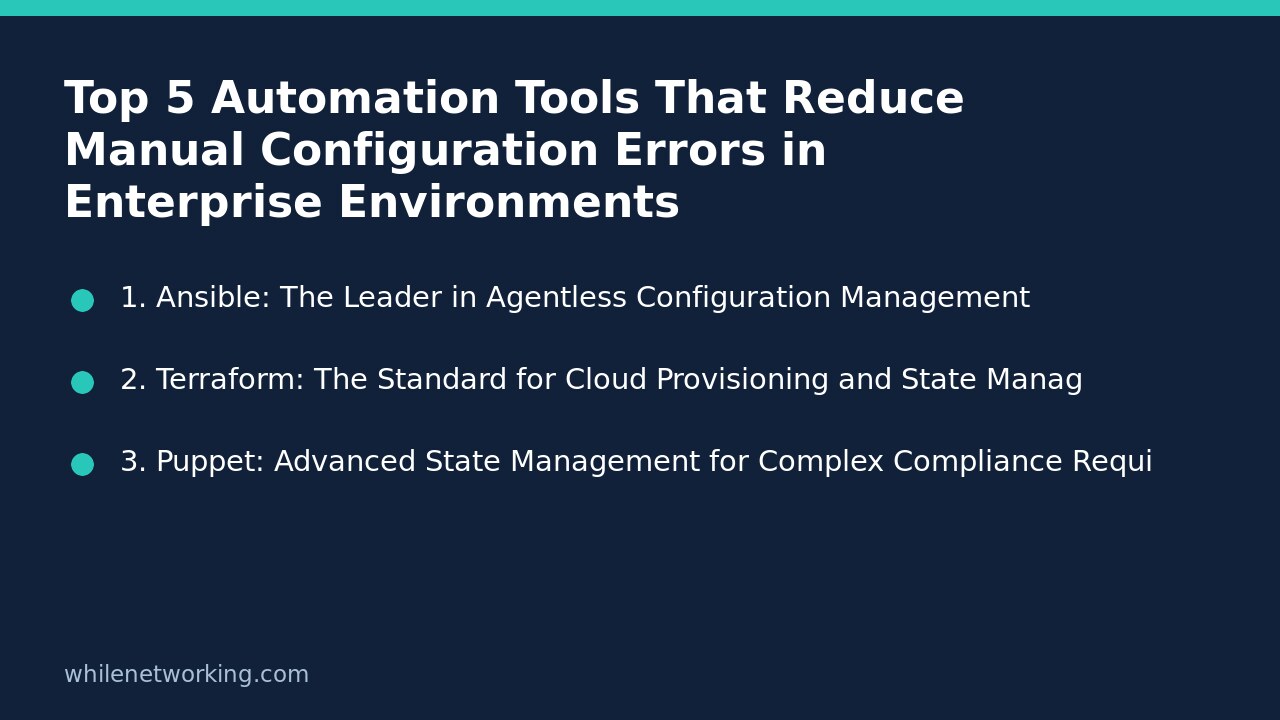
1. Ansible: The Leader in Agentless Configuration Management
Ansible stands out as one of the most widely adopted tools for configuration management due to its agentless architecture. Unlike many competitors that require installing software on every target machine, Ansible connects over SSH or WinRM to execute tasks. This reduces the attack surface and simplifies the initial setup significantly.
The tool operates using YAML-based playbooks, which define the desired state of your infrastructure. When a playbook runs, Ansible ensures that the system matches this definition exactly. If a server has been manually altered outside of the automation workflow, Ansible can detect the drift and apply the necessary changes to restore compliance. This capability is crucial for enterprises where manual tweaks by individual engineers often lead to inconsistencies.
For example, an enterprise might need to update the SSL certificates on 500 web servers simultaneously. With manual processes, this task could take days and carry a high risk of human error. Ansible can orchestrate this change in minutes, applying the same logic across all nodes while logging every action taken for audit purposes. Its idempotent nature means that running the same playbook multiple times will not cause unintended side effects; it simply ensures the state remains correct.
2. Terraform: The Standard for Cloud Provisioning and State Management
While Ansible excels at configuring existing resources, HashiCorp Terraform is the industry standard for provisioning infrastructure itself. In enterprise environments, manual creation of cloud resources via console clicks or ad-hoc scripts leads to “snowflake servers”—unique instances that do not match any documented process. Terraform eliminates this by treating infrastructure as code.
Terraform uses a declarative language to describe your desired infrastructure. It maintains a state file that tracks what resources exist and their current attributes. When you apply changes, Terraform calculates the minimal set of actions needed to reach the desired state without deleting and recreating unnecessary components. This precision is vital for preventing configuration errors such as orphaned resources or incorrect networking setups.
Consider a scenario where an organization needs to expand its database cluster in AWS. Using Terraform, engineers define the exact number of instances, storage types, and security groups required. The tool then provisions these resources consistently every time, regardless of who runs the deployment. This ensures that development, testing, and production environments are identical, removing a common source of bugs caused by environment mismatch.
3. Puppet: Advanced State Management for Complex Compliance Requirements
Puppet is renowned for its robustness in handling complex enterprise environments where compliance reporting is mandatory. It utilizes a client-server architecture with agents installed on every managed node. These agents continuously poll the server to check if the current system state matches the defined catalog. If discrepancies are found, Puppet automatically applies the necessary fixes.
The strength of Puppet lies in its ability to manage intricate dependencies and complex logic flows. For instance, an enterprise might have strict regulatory requirements mandating specific file permissions, installed software versions, and open ports. Puppet modules can encapsulate these requirements, ensuring that no single manual action violates policy. The tool also provides detailed reporting on which systems are compliant and which are not, facilitating rapid remediation of non-compliant nodes before they become security risks.
In a healthcare setting, for example, patient data servers must adhere to HIPAA standards regarding encryption and access controls. Puppet can enforce these policies across hundreds of machines, automatically disabling any unauthorized services or correcting file permissions that drift due to manual intervention. This continuous enforcement model is far superior to periodic scans that only identify problems after they have occurred.
4. Chef: Ruby-Based Automation for Fine-Grained Control
Chef offers a unique approach using Ruby as its DSL (Domain Specific Language), allowing for highly granular control over configuration logic. While this requires a steeper learning curve than YAML-based tools, it provides unparalleled flexibility for complex scenarios where standard configurations are insufficient. Chef’s infrastructure-as-code model ensures that the entire lifecycle of an application, from installation to tuning, is documented and version-controlled.
Chef excels in environments with heterogeneous operating systems or legacy applications that require specific tuning parameters. Its recipe system allows teams to break down configuration tasks into reusable components. This modularity prevents errors caused by copy-pasting large blocks of code, a common mistake in manual setups. Furthermore, Chef’s reporting dashboard offers deep insights into the health and configuration status of every node in the fleet.
A financial services firm might use Chef to manage trading algorithms running on a mix of Linux and Windows servers. Each server has unique requirements for memory allocation, network latency settings, and security patches. Chef recipes can handle these nuances consistently, ensuring that the algorithm performs identically across all nodes without manual adjustment. This level of precision is difficult to achieve with manual configuration tools.
5. Configuration Management as Code: Integrating Version Control and Security Scanning
Beyond individual tools, the practice of integrating configuration management with version control systems like Git is fundamental to reducing errors. Tools like Ansible, Terraform, and Puppet integrate seamlessly with Git repositories, allowing every change to be reviewed, tested, and approved before deployment. This workflow mirrors software development practices, bringing the benefits of CI/CD (Continuous Integration/Continuous Deployment) to infrastructure.
Security scanning tools can be integrated into this pipeline to detect vulnerabilities in configurations before they are applied. For example, a pre-commit hook might scan a Terraform file for exposed security groups or overly permissive IAM roles. If issues are found, the code is rejected, preventing the error from reaching production. This shift-left approach ensures that configuration errors are caught early in the development lifecycle rather than after deployment causes outages.
Real-World Implementation Checklist
To successfully adopt these automation tools and reduce manual errors, consider this practical checklist for your team:
- Audit Current State: Identify all systems currently configured manually or via undocumented scripts.
- Define Desired State: Document the exact configuration requirements for each system type.
- Select the Right Tool: Choose between agentless (Ansible), provisioning-focused (Terraform), or agent-based solutions (Puppet/Chef) based on your specific needs.
- Implement Version Control: Place all automation code under Git management with clear branching strategies.
- Establish Review Processes: Require peer reviews for all infrastructure changes before merging to the main branch.
- Automate Testing: Create unit tests for your playbooks or modules to ensure they function as expected in a sandbox environment.
- Monitor and Report: Set up dashboards to track compliance status and detect drift automatically.
Conclusion
Reducing manual configuration errors is not merely a matter of convenience; it is a strategic necessity for enterprise stability and security. By leveraging tools like Ansible, Terraform, Puppet, and Chef, organizations can transition from reactive firefighting to proactive infrastructure management. These tools enforce consistency, simplify compliance, and provide the audit trails necessary for modern governance. While the initial investment in learning these technologies requires effort, the long-term reduction in downtime, security incidents, and operational costs makes them indispensable assets in any enterprise IT strategy. As cloud adoption continues to grow, mastering automation will define the difference between resilient organizations and those struggling with technical debt.