
Network administrators often find themselves trapped in a cycle of repetitive manual tasks: verifying firewall rules, patching servers individually, or auditing access logs. While these activities are essential for maintaining network health, the manual execution of such duties introduces human error and slows down response times to emerging threats. The integration of automation tools offers a solution that not only accelerates operational efficiency but also fortifies the security posture by ensuring consistency and reducing the attack surface caused by oversight. By shifting from reactive, manual interventions to proactive, scripted workflows, organizations can achieve a balance where speed does not come at the cost of safety.
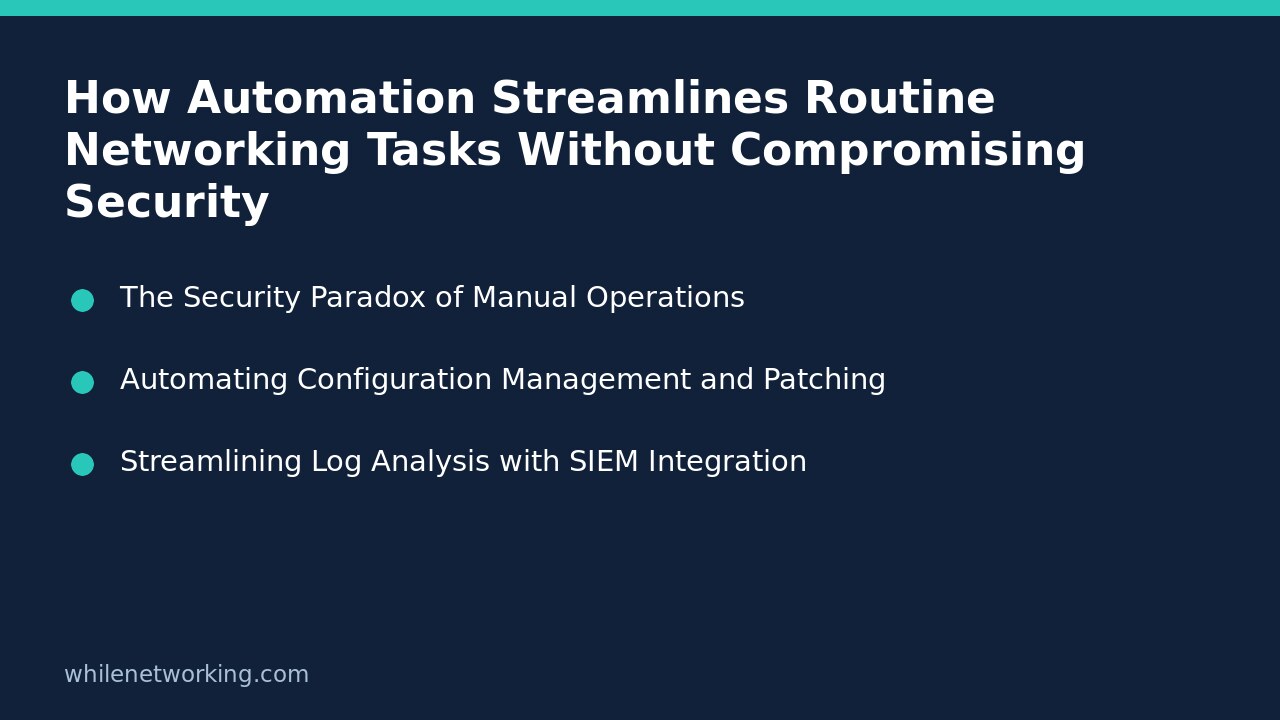
The Security Paradox of Manual Operations
The primary reason automation enhances security lies in its ability to eliminate human variability. In a manual environment, an administrator might forget to update a legacy device, misconfigure a rule during peak hours, or accidentally leave a debug port open while troubleshooting. These “fat finger” errors are among the most common vectors for breaches. Automation enforces a standardized process every single time. When a script deploys a security patch, it applies the exact same configuration to every target node without deviation. This consistency ensures that compliance standards, such as GDPR or HIPAA, are met uniformly across the infrastructure, rather than relying on an individual’s memory or diligence at any given moment.
Furthermore, manual processes are inherently slow. If a ransomware attack begins, a human team scanning for infected endpoints and isolating them manually may take hours. In that window, the malware can encrypt critical data and spread laterally. Automated detection and response systems, however, can identify anomalies based on behavioral baselines and isolate affected segments within seconds or minutes. This speed is not just about convenience; it is a critical defense mechanism that limits the dwell time of attackers within the network.
Automating Configuration Management and Patching
One of the most routine yet high-risk networking tasks is configuration management. Devices in a network often drift from their intended secure state due to cumulative changes made by different personnel over months or years. Automation tools, such as Ansible, Puppet, or Chef, allow administrators to define a “golden image” or desired state for every router, switch, and server.
Practical Implementation:
Consider a scenario where a new security policy requires all internal web servers to disable specific legacy protocols like Telnet or FTP. Manually logging into 200 servers to run this command is time-consuming and error-prone. An automation workflow can push this configuration change simultaneously across the entire fleet, verify that the change took effect, and generate a report of any devices that failed to comply immediately for further inspection.
Security Considerations:
When automating patches, it is crucial to test scripts in a staging environment first. A patch script designed for Linux servers might inadvertently break Windows-based network appliances if not properly segmented. Additionally, automation should include rollback mechanisms. If a new configuration causes instability, the automated system should be able to revert to the previous known-good state automatically, minimizing downtime and preventing service disruption.
Streamlining Log Analysis with SIEM Integration
Security Information and Event Management (SIEM) systems generate vast amounts of data daily. Manually reviewing logs for suspicious activity is impossible at scale. Automation bridges this gap by using scripts to parse, normalize, and analyze log entries from firewalls, intrusion detection systems, and servers in real-time.
Real-World Example:
Imagine a rule that flags any failed login attempt followed by a successful one within five minutes—a classic sign of credential stuffing or brute-force attacks. An automated script can monitor these logs continuously. Upon detecting the pattern, the system automatically blocks the offending IP address at the firewall level and alerts the security operations center (SOC). Without automation, this alert might sit in a queue for days until an analyst happens to check their inbox, allowing the attacker to gain full access long before detection.
Automating Vulnerability Scanning and Remediation
Vulnerability management is another area where automation provides significant benefits. Running scans manually ensures that only specific assets are checked at specific times, potentially missing newly added devices or failing to re-scan after a patch is applied. Automated scheduling tools can run vulnerability assessments on a rolling basis across the entire network topology.
Best Practices for Safe Automation:
It is vital to schedule these scans during maintenance windows to avoid flooding the network with traffic that could degrade performance. Furthermore, automation should not just identify vulnerabilities but integrate with asset management databases to ensure that critical systems are prioritized for remediation. For instance, a vulnerability in a database server holding customer PII should be flagged as high priority and patched automatically if the risk is low and the patch has been certified safe, whereas a vulnerability in a non-critical test server might be scheduled for a later patch cycle.
Common Pitfalls in Networking Automation
Despite its benefits, implementing automation carries risks if done without careful planning. A common mistake is “script fatigue,” where administrators write quick-and-dirty scripts to solve immediate problems but fail to document or version control them. These orphaned scripts can contain outdated credentials or insecure logic that becomes a liability over time.
Another frequent error is the lack of monitoring for the automation tools themselves. If the automation engine is compromised, an attacker could use it as a weapon to deploy malware across the entire network silently. Therefore, the automation infrastructure must be treated as a critical security asset, protected by multi-factor authentication, least-privilege access principles, and regular integrity checks.
Checklist for Secure Automation Deployment
Before deploying automated networking tasks, consider this checklist to ensure security is maintained:
- Define Scope: Clearly identify which assets and processes will be included in the automation workflow.
- Test in Isolation: Validate all scripts in a sandboxed environment that mirrors production but does not affect live traffic.
- Implement Rollback Plans: Ensure every automated change has a defined method to revert to the previous state if issues arise.
- Audit Credentials: Use vaults or secret managers (like HashiCorp Vault) rather than hardcoding passwords into scripts.
- Log Automation Actions: Every automated action must be logged with timestamps and user context for forensic analysis.
- Review Regularly: Schedule quarterly reviews of automation scripts to remove deprecated logic and update dependencies.
Conclusion
Automation transforms networking from a reactive, error-prone discipline into a proactive, resilient function. By automating routine tasks like configuration management, log analysis, and vulnerability scanning, organizations can achieve a higher level of security consistency than is possible through manual intervention alone. However, this power must be wielded with caution. The key to success lies in rigorous testing, proper version control, and treating automation tools as critical infrastructure that requires its own robust security measures. When implemented correctly, automation does not compromise security; rather, it builds a stronger, faster, and more reliable defense for the modern network.