
For small to medium-sized enterprises (SMEs), the transition from manual, ad-hoc IT management to a structured automation framework is often the single most effective step toward operational resilience. In today’s threat landscape, where a single misconfiguration or delayed patch can lead to a breach, manual processes are no longer viable. However, many network administrators hesitate because they fear automation requires massive budgets or complex enterprise-grade infrastructure. The reality is that scalability begins with simplicity. A robust framework does not mean over-engineering; it means creating repeatable, documented, and secure workflows that grow alongside your organization. This guide outlines the essential components for building a scalable automation framework tailored specifically for the constraints and needs of smaller networks, ensuring you achieve reliability without breaking the bank.
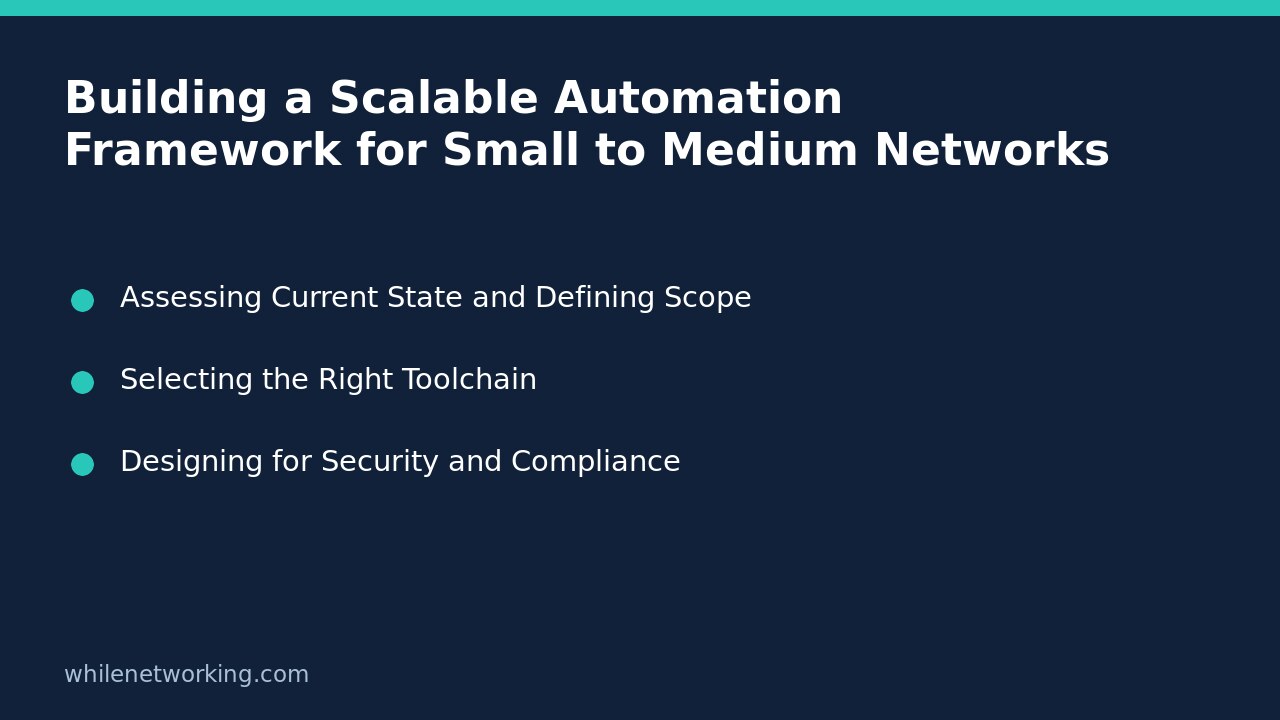
Assessing Current State and Defining Scope
Before writing a single line of code or deploying a new tool, you must understand what you are automating. The most common mistake in network automation is attempting to automate every task immediately, leading to fragile scripts that break when hardware changes. Instead, start by auditing your current operational processes. Identify which tasks are repetitive, error-prone, and time-consuming. Common candidates include user onboarding, firewall rule updates, patch management verification, and log aggregation.
Once identified, categorize these tasks based on their risk profile and frequency. High-frequency, low-risk tasks (like checking disk space) can be fully automated immediately. Medium-risk tasks (like applying patches) require a “human-in-the-loop” approval step before execution. Critical infrastructure changes should remain manual or require multi-person verification until the framework is mature. Define clear success metrics for each task. For example, if you automate user provisioning, your metric might be reducing setup time from two days to two minutes while maintaining 100% compliance with security policies.
Selecting the Right Toolchain
The choice of tools often dictates the ceiling of your automation capabilities. For SMEs, it is crucial to avoid vendor lock-in and proprietary scripts that only work on specific hardware. The industry standard for network automation involves a combination of configuration management tools and scripting languages. Ansible remains a top choice for many small networks due to its agentless architecture, which means you do not need to install software on every switch or server; it connects via SSH or HTTPS. This reduces overhead and security risks associated with managing agents on unpatched devices.
Python is the lingua franca of network automation, offering vast libraries like Netmiko and Nornir that simplify device interaction. For infrastructure as code (IaC), Terraform allows you to define your entire network topology in text files, ensuring that what you build matches what you intend. When selecting tools, prioritize open-source solutions where possible to maintain control over your security posture. Avoid “point solutions” that claim to solve one problem but require expensive licenses and create data silos. A unified dashboard that ingests logs from various sources provides better visibility than ten different alerts sent to ten different email addresses.
Designing for Security and Compliance
Security must be baked into the automation framework, not bolted on as an afterthought. In an automated environment, a compromised script or a misconfigured pipeline can propagate malware across the entire network faster than a human could contain it. Implement strict identity management protocols immediately. Never use hardcoded credentials in scripts; instead, integrate with secure vaults like HashiCorp Vault or utilize environment variables managed by your configuration control system.
Every automated action should be logged and auditable. If an automation tool modifies a firewall rule, that change must be recorded with a timestamp, the user ID, and the reason for the change. This is essential for compliance audits in regulated industries. Furthermore, adopt a “immutable infrastructure” mindset where possible. Rather than patching production servers directly, create new instances with updates applied during deployment, then retire the old ones. Automation makes this tedious process efficient by spinning up new environments on demand. Always test your automation scripts in an isolated sandbox environment that mirrors your production network before applying changes live. This prevents catastrophic outages caused by a script intended for a specific router model but accidentally run on a legacy device.
Implementing Continuous Monitoring and Feedback Loops
Automation is not a “set it and forget it” solution; it requires active monitoring to ensure stability. Build feedback loops into your framework where automation tools report their own health status. If an Ansible playbook fails to connect to a switch, the system should automatically retry once, then alert the administrator if the issue persists. Utilize orchestration platforms that can visualize dependencies between different network components. For instance, if you are automating a DNS update, ensure the script verifies that the change propagated correctly before marking the task as complete.
Integrate your automation logs with a centralized SIEM (Security Information and Event Management) system or a simple log aggregator like ELK Stack. This allows you to correlate events across different devices. If a specific type of error spikes in your logs, you can investigate whether it is a transient network issue or a bug in your script. Regularly review these logs to refine your playbooks. Over time, this data helps you identify patterns, such as certain firmware versions being incompatible with specific automation modules, allowing you to proactively address compatibility issues before they cause downtime.
Real-World Example: Automating User Onboarding
To illustrate how this framework functions in practice, consider the common scenario of a new employee joining the company. In a manual environment, this involves an IT technician logging into three different consoles to create accounts on Active Directory, provisioning a laptop image, and configuring email aliases. This process takes hours and is prone to human error, such as typing the wrong username or missing a security group assignment.
With a scalable automation framework, you define a single YAML file in Ansible that handles the entire lifecycle. The script pulls user details from an HR system via API, creates the necessary accounts on domain controllers, provisions a virtual machine or physical device using your provisioning tool, and configures the endpoint management agent. Crucially, the script checks for compliance policies immediately after setup, ensuring the new device meets security standards before the user logs in. If any step fails, the framework notifies the HR department to cancel the hire, preventing orphaned accounts that could become security liabilities. This example demonstrates how automation transforms a chaotic, manual task into a predictable, secure, and rapid process.
Conclusion: Iteration is Key
Building a scalable automation framework for small to medium networks is a journey of continuous improvement. It requires discipline in documentation, vigilance in security practices, and the humility to admit when a script needs rewriting. Start small with low-risk tasks, validate your approach, and gradually expand the scope as your team gains confidence. Remember that technology alone does not guarantee success; it must be supported by clear policies and trained personnel who understand the logic behind the automation. By following these steps, SMEs can achieve enterprise-level efficiency and security without the associated costs, positioning themselves for sustainable growth in a digital-first world.