
Adopting a multi-cloud strategy has become a standard practice for enterprise organizations seeking to avoid vendor lock-in, optimize costs, and enhance resilience. However, managing infrastructure across Amazon Web Services (AWS), Microsoft Azure, and Google Cloud Platform (GCP) introduces significant complexity that single-cloud environments do not face. The primary challenge is not merely running services on three different platforms but orchestrating them cohesively to maintain security compliance, operational efficiency, and consistent user experiences. Success requires a deliberate architectural approach that treats the cloud environment as a unified whole rather than a collection of disparate silos.
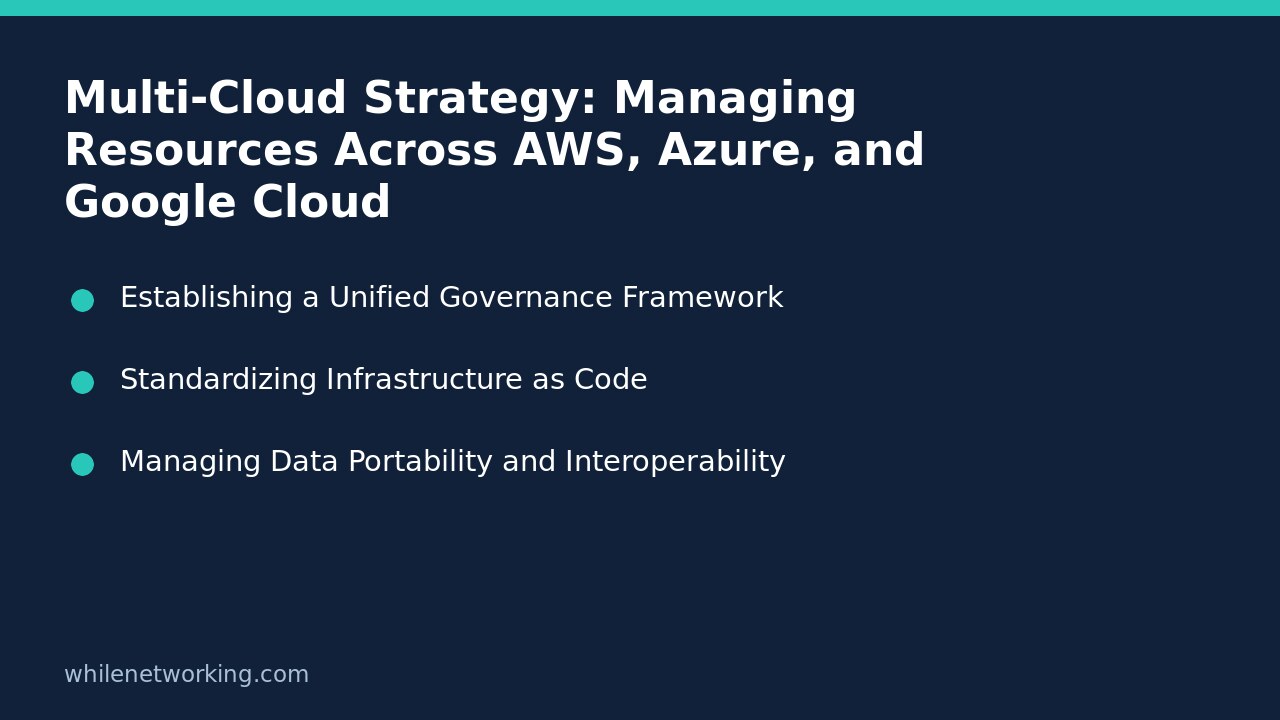
Establishing a Unified Governance Framework
The foundation of any successful multi-cloud strategy is robust governance. Without a central framework, teams often drift into “shadow IT,” where resources are provisioned in one cloud without adhering to the security policies of another. To prevent this, organizations must implement Identity and Access Management (IAM) controls that span all three providers.
Rather than managing separate identity stores, many enterprises adopt an identity federation model using protocols like SAML or OIDC. This allows a user’s credentials from a central directory, such as Microsoft Entra ID (formerly Azure AD), to authenticate across AWS IAM, Azure Active Directory, and Google Cloud Identity. For example, if an employee leaves the company, a single action in the central directory can revoke access to all cloud accounts simultaneously, eliminating the risk of orphaned credentials lingering in one vendor’s system while being removed from another.
Furthermore, policy enforcement must be consistent. Tools like Open Policy Agent (OPA) or commercial equivalents can be used to define rules once and apply them across different infrastructure-as-code templates. This ensures that a security requirement defined for AWS Security Groups is automatically translated into Azure Network Security Groups and GCP Firewall rules, reducing the administrative burden of manual configuration.
Standardizing Infrastructure as Code
Manual provisioning is a recipe for inconsistency and error in a multi-cloud environment. To achieve parity across AWS, Azure, and GCP, organizations must rely heavily on Infrastructure as Code (IaC). While each provider has its native toolset—AWS CloudFormation, Terraform, Azure Resource Manager (ARM) templates, and Google Deployment Manager—the industry standard has shifted toward Terraform due to its cloud-agnostic nature.
Using Terraform allows teams to write a single set of code blocks that define resources regardless of the underlying provider. For instance, defining an EC2 instance in AWS, a Virtual Machine Scale Set in Azure, and a Compute Engine instance in GCP might require different syntax within the same state management logic. By leveraging providers for each cloud within a Terraform workspace, operations teams can manage the lifecycle of these disparate resources with a unified workflow. This approach simplifies disaster recovery; if one region or provider fails, scripts can automatically provision equivalent capacity in another environment without rewriting the entire architecture from scratch.
Managing Data Portability and Interoperability
One of the most difficult aspects of multi-cloud strategy is data movement. Data residency laws often dictate where specific datasets must reside, yet applications may need to query data across regions or even different clouds for analytics. The goal is to avoid “data gravity” traps where migrating data becomes prohibitively expensive due to egress fees and latency issues.
A practical solution involves establishing a central data lake layer that aggregates data from all sources before it reaches the application layer. Tools like Apache Iceberg or Delta Lake can run on object storage in any cloud, providing a unified table format that applications can query regardless of where the underlying storage resides (S3, Azure Blob, or GCS). Additionally, utilizing managed data transfer services, such as AWS Snowball for physical transfers or Google Transfer Manager, can help move large datasets between clouds when direct replication is not feasible. It is crucial to implement strict encryption standards both in transit and at rest, ensuring that data remains secure even when crossing the boundaries of different cloud ecosystems.
Implementing Cross-Cloud Security Monitoring
Security visibility in a multi-cloud environment often suffers from fragmentation. An alert generated by AWS CloudWatch might go unnoticed if an engineer is only monitoring Azure Log Analytics dashboards. To combat this, organizations should deploy a centralized logging and monitoring solution that ingests metrics from all three platforms.
Open-source solutions like Prometheus with remote write capabilities or commercial SIEM (Security Information and Event Management) platforms can aggregate logs from AWS CloudTrail, Azure Monitor, and Google Cloud Operations suite into a single pane of glass. This allows security teams to correlate events across clouds. For example, if an unusual login attempt occurs in AWS, the system can automatically check for similar anomalies in Azure or GCP using shared threat intelligence feeds. Additionally, adopting a zero-trust architecture is essential. Identity should be the primary method of access control, rather than network perimeters, ensuring that no single compromised cloud account provides unrestricted access to the entire enterprise infrastructure.
Real-World Example: A Unified Disaster Recovery Plan
Consider a financial services firm operating critical workloads across AWS in the US-East region, Azure in Europe-West for GDPR compliance, and GCP in Asia-Pacific for low-latency trading algorithms. Their disaster recovery (DR) strategy must account for these specific constraints.
In this scenario, the primary application logic resides in AWS. If an outage occurs in the US-East region, traffic is automatically routed to a secondary environment hosted on Azure. However, because the data formats differ slightly between S3 and Azure Blob Storage, the architecture includes a translation layer that normalizes data schemas before the application reads them. Simultaneously, the GCP instance serves as a cold standby for specific regulatory reporting workloads that must remain physically located in Asia.
The recovery plan involves automated scripts triggered by health checks. If AWS detects an unresolvable failure, it triggers a Terraform script to spin up equivalent compute resources in Azure within 15 minutes. During this transition, the application seamlessly shifts its connection strings via a service mesh like Istio or Linkerd, which handles the routing logic without requiring code changes. This example illustrates that a successful multi-cloud strategy requires not just technical capability but also rigorous testing of failover procedures to ensure business continuity is maintained regardless of which cloud provider experiences an incident.
Common Pitfalls and Best Practices Checklist
Even with careful planning, organizations often stumble into common traps. One frequent mistake is over-reliance on proprietary tools that lock a team into a specific vendor’s ecosystem. Another is neglecting cost management; pricing models differ significantly between AWS, Azure, and GCP, and what is cheap in one may be expensive in another.
To navigate these challenges, consider the following checklist for maintaining a healthy multi-cloud strategy:
* Audit regularly: Conduct quarterly reviews of resource usage across all three clouds to identify idle instances or over-provisioned storage.
* Standardize naming conventions: Ensure that resource tags and naming structures are consistent so that billing reports and inventory scans can be aggregated easily.
* Train cross-functionally: Ensure that DevOps engineers understand the basics of at least two cloud providers, preventing knowledge silos where only one person knows how to manage a specific environment.
* Test failovers annually: Run simulated disaster scenarios to verify that automated migration paths between clouds function as expected without data loss.
Conclusion
Building a multi-cloud strategy involving AWS, Azure, and Google Cloud is an ambitious undertaking that offers significant benefits in flexibility, cost optimization, and risk mitigation. However, it demands a mature operational approach centered on unified governance, standardized infrastructure-as-code practices, and robust cross-cloud security monitoring. By treating the entire cloud ecosystem as a single logical unit rather than separate silos, organizations can leverage the unique strengths of each provider while minimizing the complexities associated with managing multiple environments. The key to success lies in disciplined execution, continuous learning, and a commitment to maintaining portability and control over data assets regardless of the underlying infrastructure.