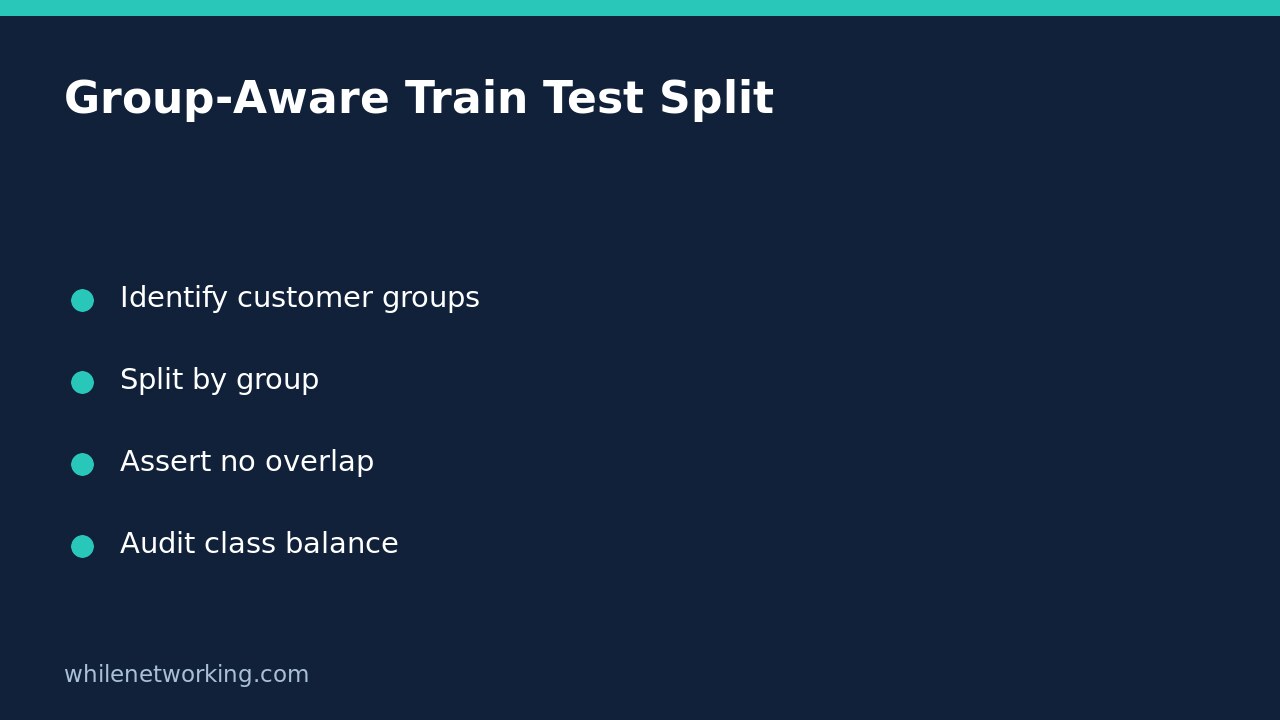

If your dataset contains several rows per customer, a random row split can put the same customer in both training and testing. When the goal is predicting for previously unseen customers, split using customer identifiers as groups instead. In scikit-learn, GroupShuffleSplit produces train and test indices while keeping each group on one side within a split.
This tutorial uses deliberately synthetic identifiers and measurements. They illustrate indexing, not business performance. Use it for educational purposes, test carefully before production, and protect real customer data. The site owner is not responsible for misuse, damage, data loss or production issues.
First decide what the test set should represent
A group split answers a specific evaluation question: how does a model perform on entities absent from its training data? Customer, patient, machine or household identifiers can be appropriate groups when repeated observations from the same entity are related. Choose the grouping boundary using your intended deployment, not whichever column makes a score look attractive.
If instead the task is forecasting later behaviour for existing customers, a random customer holdout may not answer the deployment question. You may need a chronological evaluation, potentially with additional group restrictions. GroupShuffleSplit does not automatically enforce past-before-future ordering.
Create an isolated example and inspect the indices
Use a disposable virtual environment rather than changing system Python. In a terminal, the following commands create an environment and install the two libraries used by the example. On Windows, the activation command differs.
python3 -m venv .venv-groups
. .venv-groups/bin/activate
python3 -m pip install numpy scikit-learn
Save this Python example as split_groups.py. Each invented customer has two rows. The identifier is metadata for splitting; it is not added to the feature matrix.
import numpy as np
from sklearn.model_selection import GroupShuffleSplit

# Synthetic teaching data, not a real customer dataset.
groups = np.repeat(np.arange(10), 2)
X = np.arange(40, dtype=float).reshape(20, 2)
y = np.tile([0, 1], 10)

splitter = GroupShuffleSplit(
    n_splits=1, test_size=0.2, random_state=42
)
train_idx, test_idx = next(splitter.split(X, y, groups))

train_groups = set(groups[train_idx])
test_groups = set(groups[test_idx])
assert train_groups.isdisjoint(test_groups)
assert len(train_idx) + len(test_idx) == len(X)

X_train, X_test = X[train_idx], X[test_idx]
y_train, y_test = y[train_idx], y[test_idx]
print("Training groups:", sorted(train_groups))
print("Testing groups:", sorted(test_groups))
print("Rows:", len(train_idx), len(test_idx))
Run it with python3 split_groups.py. The assertions check separation and total row accounting in this single split. They do not establish that the features are valid, that the labels are correct or that the eventual model generalises.
Understand why group percentage is not row percentage
The official API reference specifies that test_size and train_size refer to groups, not samples. A fractional test_size is the fraction of unique groups assigned to testing, with the test-group count rounded up. In this teaching example every group has equal size. Real customers often contribute very different numbers of records.
Consequently, holding out a fraction of customers need not hold out the same fraction of rows. Inspect both counts. A small number of unusually active customers can dominate the test observations. Decide whether a row-level metric, a customer-level summary or both fit your operational question; do not silently treat those measures as interchangeable.
Keep preprocessing and identifiers from leaking information
In a real table, validate that every row has a meaningful group identifier and that spelling or formatting differences do not split one customer into several apparent groups. Investigate missing identifiers before splitting. Check for duplicate records across different identifiers as well, since a group splitter cannot discover identity mistakes for you.
Fit imputation, scaling and learned feature transformations only on the training partition. Our SimpleImputer pipeline tutorial explains the related preprocessing leakage problem. A correct group boundary does not fix preprocessing fitted on the entire dataset.
Audit repeated splits and class balance
Setting n_splits above one generates multiple random group holdouts. The documentation warns that test sets from different splits can overlap. This is not the same as each group appearing in exactly one test fold. Do not concatenate repeated test predictions and describe them as a single non-overlapping holdout.
Also inspect class counts in each training and test partition. This splitter is group-aware, not a promise of class stratification. If a rare outcome is confined to very few customers, group separation can leave a partition without that outcome. Reconsider the evaluation design rather than repeatedly changing random seeds until a favourable score appears.
Final checklist and common questions
- Does the group represent the entity you need to hold out?
- Are train and test groups disjoint within each split?
- Have you inspected group counts, row counts and labels?
- Is preprocessing learned only from training data?
- Does the evaluation respect any necessary time ordering?
Does random_state guarantee reproducibility forever? An integer controls the random split for repeated calls, as documented. Also record the data snapshot, row order, group definitions and library environment when preserving an experiment.
How do I undo the lab? Run deactivate to leave the virtual environment. The example changes no production records and trains no deployed service. Keep or remove the disposable project folder through your usual file-management process after checking its contents.
Source
scikit-learn GroupShuffleSplit API reference: grouping semantics, fractional sizes, random_state and overlapping repeated test sets.