
Traditional network stress testing often relies on static scripts or repetitive loops that fail to mimic the chaotic, unpredictable nature of real-world user behavior. These artificial patterns can lead to false positives where a system appears robust against simple attacks but crumbles under complex, multi-vector loads. Generative AI transforms this landscape by synthesizing traffic patterns that are statistically similar to production environments without replicating actual sensitive data. By leveraging Large Language Models (LLMs) and generative adversarial networks (GANs), engineers can create diverse attack vectors, simulate specific user cohorts, and generate realistic API call sequences that challenge system boundaries in ways previously impossible with deterministic tools.
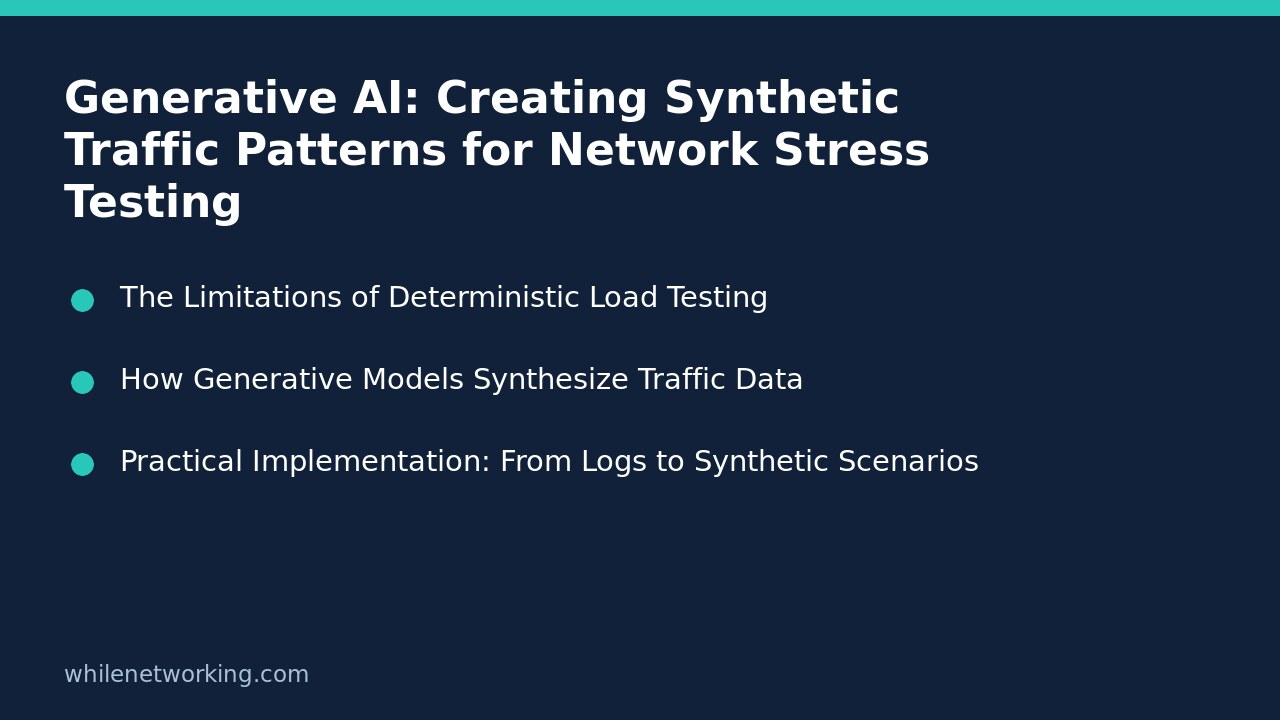
The Limitations of Deterministic Load Testing
Before adopting AI-driven approaches, it is essential to understand why traditional methods fall short. Conventional load testing tools typically use “ping pong” scenarios or fixed-rate request generators. These methods assume all users behave identically and hit the server at uniform intervals. In reality, network traffic exhibits heavy-tailed distributions; a small percentage of requests often consume the majority of resources.
Deterministic scripts cannot easily replicate:
* Temporal Variance: The specific time-of-day spikes caused by lunch breaks or global business hours.
* Session Complexity: The intricate navigation paths users take between login, data retrieval, and checkout.
* Error Handling Diversity: How legitimate users react to timeouts, 404 errors, or partial failures.
When testers force a system to handle only these rigid patterns, they miss critical failure points that emerge from the randomness of human interaction. Generative AI fills this gap by learning the statistical fingerprints of your existing logs and then generating new, unseen sequences that adhere to those same probabilistic rules.
How Generative Models Synthesize Traffic Data
The core mechanism involves training a model on historical network traffic data—specifically metadata such as request headers, payload sizes, latency distributions, and user agent strings. Crucially, the training process must be strictly unsupervised or use synthetic labels to ensure no Personally Identifiable Information (PII) leaks into the generated output.
Once trained, the AI model acts as a simulator. Instead of replaying old logs, it samples from its learned probability distributions to create new traffic scenarios. For example, if historical data shows that 15% of users abandon a cart after viewing a product page, the generative model will naturally introduce this behavior into the synthetic traffic stream without needing an explicit script instruction. This approach allows for the creation of “edge case” scenarios where rare but impactful events occur simultaneously, such as a flash sale combined with a DDoS-like surge in specific geographic regions.
Practical Implementation: From Logs to Synthetic Scenarios
Implementing this technology requires a structured pipeline that prioritizes security and accuracy. The process generally follows these steps:
- Data Ingestion and Sanitization: Collect logs from firewalls, load balancers, and application servers. Immediately strip any PII (usernames, emails, IP addresses) before feeding data into the training environment.
- Feature Extraction: Identify key variables such as request frequency, payload structure, session duration, and error codes. These features form the basis of the generative model’s understanding of “normal” traffic.
- Model Training: Utilize frameworks like PyTorch or TensorFlow to train a Variational Autoencoder (VAE) or a GAN. The goal is to reconstruct the input data so accurately that the generator can produce novel yet realistic outputs.
- Scenario Generation: Configure the model to generate traffic profiles for specific stress tests, such as “Peak Holiday Shopping” or “Legacy Browser Migration.”
- Injection and Monitoring: Route the synthetic traffic through a traffic shaper or proxy layer into your test environment, ensuring it blends seamlessly with real traffic if needed, or operates in isolation for pure stress testing.
Security Considerations and Data Privacy
A common misconception is that generating synthetic data automatically solves privacy concerns. In reality, generative models can sometimes memorize training data, leading to “membership inference” attacks where an adversary might reconstruct sensitive information from the generated output. To mitigate this, organizations must employ differential privacy techniques during the training phase. This involves adding mathematical noise to the gradients of the model, ensuring that the presence or absence of any single individual in the training dataset does not significantly alter the model’s output.
Furthermore, strict access controls must be maintained around the synthetic data generation pipeline. Only authorized security engineers and DevOps teams should have access to the models and the resulting traffic patterns. Regular audits should verify that the generated payloads do not inadvertently recreate real user sessions or expose internal infrastructure details like database schemas in error messages.
Real-World Example: Simulating a Global Flash Sale
Consider an e-commerce platform preparing for a Black Friday event. Historically, they used static scripts to simulate 10,000 concurrent users. However, the previous year’s crash occurred not because of high concurrency alone, but due to a specific sequence: a sudden influx of traffic from Southeast Asia followed immediately by a spike in image-heavy requests from Europe, causing bandwidth saturation and database connection pooling issues.
Using a generative AI approach, the team ingested two years of traffic logs. They trained a model to understand the correlation between geographic location, time of day, and request type. During the simulation, they instructed the AI to generate a scenario that mimicked this specific geographic shift but with higher intensity than ever recorded historically. The system successfully identified that their database connection poolers would drop connections under this specific multi-vector load, which static testing had missed. The team could then tune their infrastructure specifically for this pattern, ensuring a smooth event.
Common Pitfalls in AI-Driven Stress Testing
Even with advanced tools, engineers can make mistakes when integrating generative AI into their workflow. One frequent error is overfitting the model to historical data. If the model is too closely tied to past performance metrics, it may fail to predict future anomalies or novel attack patterns. Engineers must ensure the validation set used for testing the model contains data from periods that differ significantly from the training set.
Another pitfall is ignoring the “black box” nature of deep learning models. Without interpretability tools, it can be difficult to understand why the AI generated a specific traffic spike. Teams should employ techniques like SHAP (SHapley Additive exPlanations) to analyze feature importance and ensure the generated scenarios are logically sound. Finally, never run generative stress tests against production environments without rigorous isolation. Synthetic traffic can still cause cascading failures if not throttled correctly; always validate the injection rate in a staging environment first.
Conclusion: The Future of Resilient Infrastructure
Generative AI represents a paradigm shift in network stress testing, moving from reactive replication to proactive simulation. By creating synthetic traffic patterns that capture the complexity and randomness of real-world usage, organizations can uncover hidden vulnerabilities before they impact customers. While challenges regarding data privacy and model interpretability exist, they are manageable through rigorous engineering practices and differential privacy standards. As AI models become more sophisticated, the ability to simulate increasingly complex digital behaviors will become a standard requirement for maintaining resilient, high-performance infrastructure in an unpredictable digital landscape.