
In the rapidly evolving landscape of cyber security, zero-day attacks represent one of the most dangerous challenges for organizations worldwide. Unlike traditional malware that relies on known signatures, zero-day exploits target unknown vulnerabilities in software or hardware before a patch is available. Because these threats lack defined patterns, legacy detection systems often fail to recognize them until it is too late. This is where AI-driven threat detection becomes essential. By leveraging machine learning algorithms and behavioral analysis, security teams can identify anomalies that suggest an attack is underway, even when the specific vulnerability has never been seen before. The goal is not just to react to breaches but to predict and intercept them in their earliest stages.
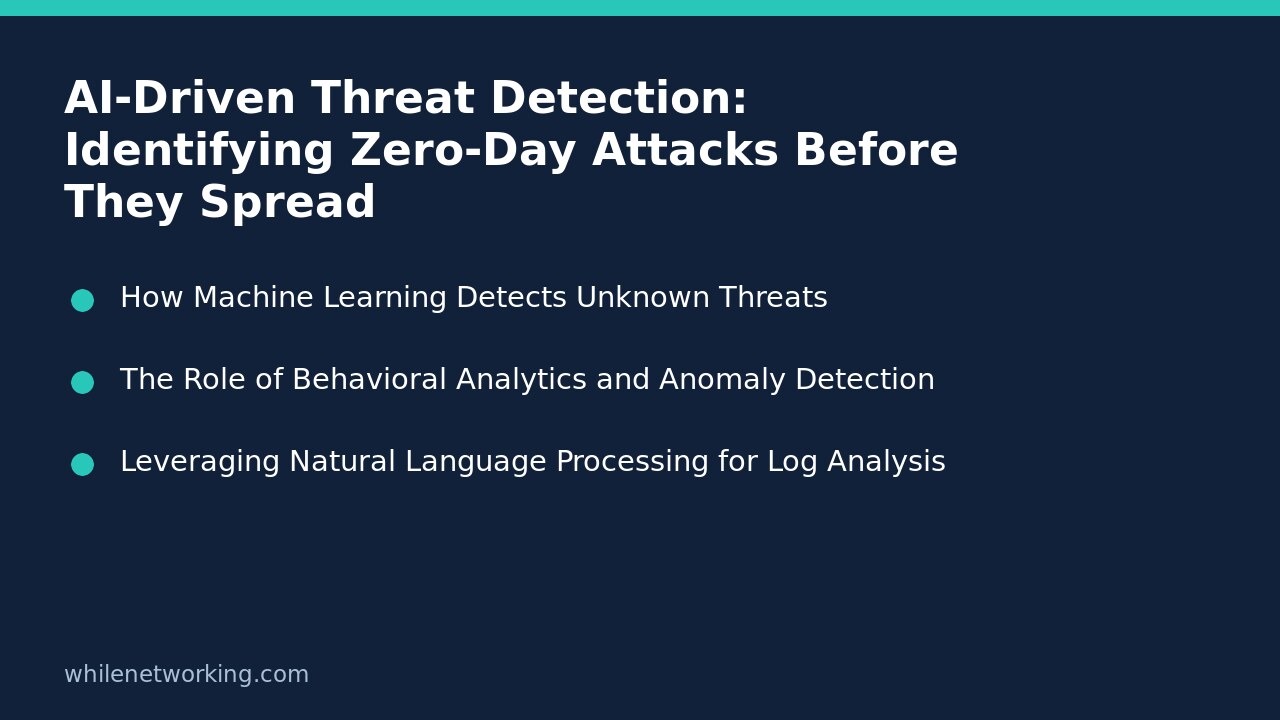
How Machine Learning Detects Unknown Threats
Traditional antivirus software operates on a signature-based model, meaning it looks for known “fingerprints” of malicious code. If a virus has never been cataloged, the system ignores it. AI-driven detection shifts this paradigm by focusing on behavior rather than signatures. Machine learning models are trained on vast datasets of normal network traffic and user activities. They learn what constitutes baseline behavior for a specific environment, such as typical login times, data transfer volumes, and application usage patterns.
When an event deviates significantly from this baseline, the AI flags it as a potential threat. For example, if a server suddenly begins encrypting files at an unprecedented rate or if an employee account attempts to access sensitive databases outside of normal business hours, the system generates an alert. This approach allows security operations centers (SOC) to spot zero-day attacks that mimic legitimate activity but exhibit subtle irregularities in timing, frequency, or destination.
The Role of Behavioral Analytics and Anomaly Detection
At the core of AI-driven threat detection lies behavioral analytics. These systems continuously monitor endpoints, networks, and cloud environments to establish a dynamic profile of normal operations. Unlike static rules that require constant manual updates by security analysts, AI models adapt in real-time as the environment changes. This adaptability is crucial for zero-day scenarios where attackers constantly modify their tactics to evade detection.
Anomaly detection algorithms use techniques such as unsupervised learning to find hidden patterns and structures in data without prior labeling of what constitutes an attack. For instance, a new ransomware strain might not have any known code snippets, but it might exhibit a specific sequence of commands or a unique method of lateral movement across a network. AI systems can cluster similar behaviors and isolate outliers that do not fit established groups. This capability enables the identification of sophisticated threats like fileless malware or living-off-the-land techniques (LOLT), where attackers use legitimate system tools to compromise networks without leaving traditional forensic artifacts.
Leveraging Natural Language Processing for Log Analysis
Another critical component of AI-driven defense is Natural Language Processing (NLP). Security logs generated by firewalls, intrusion detection systems, and endpoint agents often contain unstructured text data that humans struggle to analyze at scale. NLP models can parse these logs to detect semantic anomalies indicative of an attack. For example, if a log entry mentions an unusual error code associated with a rarely triggered vulnerability, or if the phrasing of a command line argument matches patterns seen in previous zero-day incidents, the AI can flag the event for immediate review.
This technology also aids in correlating events across different systems. A zero-day attack might start as a small spike in DNS queries followed by a subtle change in registry keys. NLP-enhanced analytics can connect these disparate data points into a coherent narrative, revealing the attacker’s progression before significant damage occurs. This holistic view is vital for understanding the scope of an incident and preventing it from spreading laterally across the infrastructure.
Real-World Example: Detecting a Supply Chain Compromise
Consider a real-world scenario involving a supply chain attack, which often relies on zero-day vulnerabilities in third-party software updates. Imagine a company receives a critical security patch for its web server that inadvertently contains malicious code designed to steal credentials. Traditional scanners might miss this if the malware is embedded deeply within legitimate-looking update scripts. However, an AI-driven system monitoring deployment processes could detect anomalies such as unexpected changes in script execution speed, unusual outbound connections from the server during the update process, or deviations in file integrity hashes that differ slightly from known-good baselines.
In this scenario, the AI does not wait for a signature match; instead, it notices that the patch installation took three times longer than usual and triggered a secondary process that communicated with an unknown external IP address. The system automatically isolates the affected server and alerts the security team. This early intervention prevents the malware from spreading to other servers in the cluster or exfiltrating customer data. Such examples highlight how AI transforms passive monitoring into active threat hunting, turning potential vulnerabilities into manageable incidents before they become breaches.
Common Mistakes in Implementing AI Security Solutions
Despite its power, implementing AI-driven threat detection comes with pitfalls that organizations must avoid. One common mistake is relying solely on automated alerts without human oversight. AI systems can produce false positives, especially during periods of high network activity or when legitimate changes occur. If a SOC team ignores all alerts to reduce noise, they risk missing genuine zero-day attacks. The best practice is to use AI as a triage tool that prioritizes incidents for human analysts rather than replacing them entirely.
Another error involves failing to update training data regularly. AI models degrade over time if they are not retrained with the latest threat intelligence and internal network changes. Attackers also employ adversarial machine learning techniques to fool AI models by introducing subtle perturbations in their attack signatures. Organizations must maintain diverse datasets and continuously validate model accuracy against emerging threats. Additionally, there is a tendency to treat all AI outputs as infallible, leading to overconfidence in automated responses that could disrupt business operations if the AI misidentifies a legitimate process as malicious.
Best Practices for Maximizing Zero-Day Defense
To maximize the effectiveness of AI-driven threat detection, organizations should adopt a layered security strategy known as defense in depth. This involves combining AI tools with traditional firewalls, endpoint detection and response (EDR) solutions, and zero-trust architecture. Regular red team exercises can help validate whether the AI system correctly identifies simulated zero-day attacks. Furthermore, establishing clear incident response playbooks ensures that when an AI raises a flag, the response is swift and coordinated.
It is also essential to integrate threat intelligence feeds into the AI training pipeline. By ingesting global data on emerging vulnerabilities and attack vectors, local AI models can learn from worldwide incidents without necessarily experiencing the attack themselves. Finally, fostering a culture of continuous learning among security staff ensures they understand how to interpret AI insights and make informed decisions under pressure.
Conclusion
AI-driven threat detection offers a necessary evolution in cyber defense against zero-day attacks. By shifting focus from known signatures to behavioral anomalies and leveraging advanced analytics like NLP, organizations can identify threats before they spread. While no system is perfect, the combination of machine learning adaptability with human expertise creates a robust shield against unknown dangers. As attackers continue to innovate, the only viable path forward is to embrace intelligent, proactive security measures that learn and evolve alongside the threat landscape.