
Network automation is no longer just a buzzword for enterprise IT departments; it is a critical component of modern infrastructure management. As networks grow more complex with the influx of IoT devices, cloud services, and hybrid environments, manual configuration and monitoring have become unsustainable sources of error and downtime. However, the decision to invest in automation tools requires a rigorous cost-benefit analysis. This article explores when the shift from manual operations to automated workflows makes financial and operational sense, helping organizations determine if the time is right for implementation.
The primary driver for automation should be the reduction of Mean Time to Repair (MTTR) and Mean Time to Resolve (MTTR). Manual processes are prone to human error, such as misconfigurations during device upgrades or failed change deployments that take days to identify. Automation scripts can detect anomalies, isolate faults, and apply patches in minutes rather than hours. The benefit here is not just speed; it is reliability. A single hour of unplanned downtime can cost a mid-sized business thousands of dollars in lost productivity and reputation damage. If your current operations team spends more than 15-20% of their time on repetitive, low-value tasks like patching routers or verifying IP address assignments, the return on investment (ROI) for automation becomes immediate.
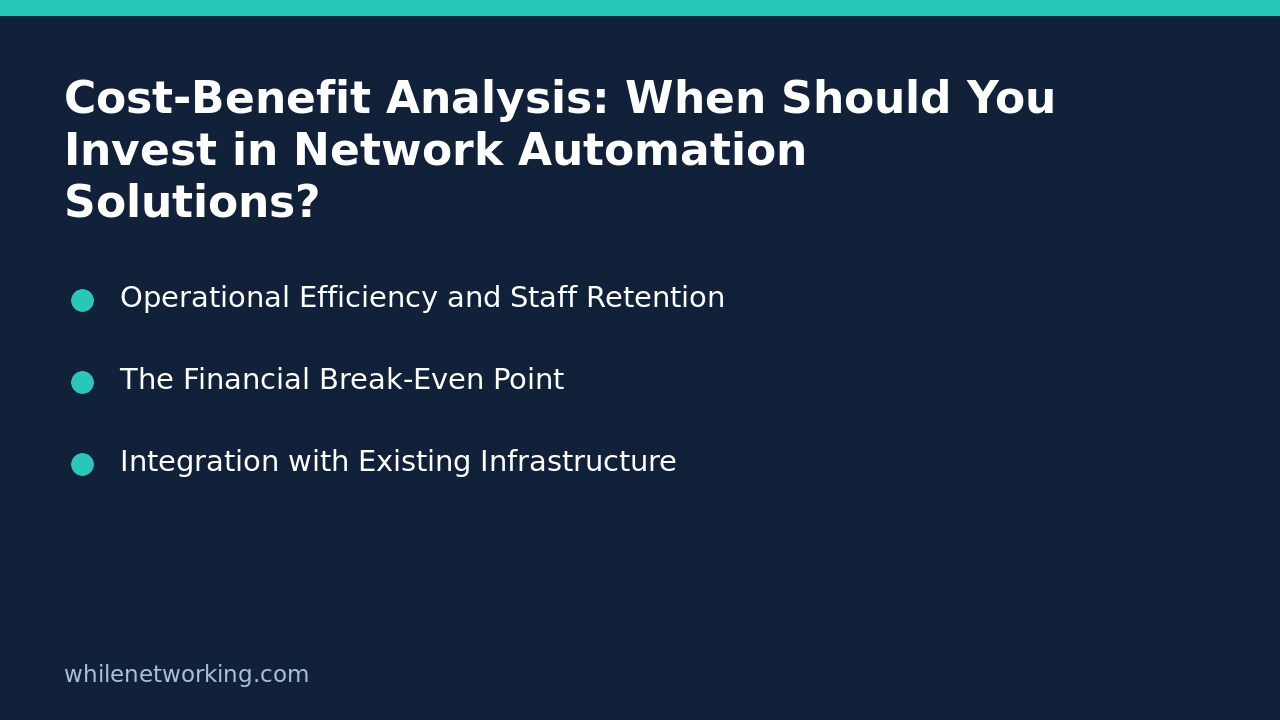
Operational Efficiency and Staff Retention
One of the most overlooked benefits of network automation is its impact on human capital. Junior engineers often spend years mastering rote configuration commands that automation tools handle instantly. By automating these mundane tasks, organizations can redirect skilled staff toward strategic initiatives like security architecture design or capacity planning. This shift improves job satisfaction and aids in retaining talent, as network professionals increasingly demand opportunities to work with modern technologies rather than legacy CLI (Command Line Interface) drudgery.
Furthermore, automation standardizes operations. In a manual environment, Engineer A might configure a firewall rule differently from Engineer B, leading to security inconsistencies. Automation enforces a “single source of truth,” ensuring that every device adheres to the desired baseline configuration. This consistency reduces the attack surface and simplifies compliance audits, which are becoming increasingly stringent across various industries.
The Financial Break-Even Point
While the intangible benefits like staff retention are valuable, the financial break-even point is often the deciding factor for stakeholders. To calculate this, organizations must sum the costs of automation software licenses, hardware upgrades (if necessary), and training against the savings generated by reduced overtime, fewer failed changes, and lower incident response costs.
A common mistake is underestimating the cost of not automating. If a manual process takes four hours to complete but carries a 10% risk of error that results in a two-hour outage every month, the “cost” of that manual process includes the hidden expense of fixing the resulting incident. Automation eliminates the error risk entirely. For example, if an automated script prevents one major outage per year that would have cost $50,000 in remediation and downtime, the tool pays for itself immediately, even if it costs $20,000 annually to license.
Integration with Existing Infrastructure
Before investing, it is crucial to assess compatibility with existing infrastructure. Many legacy devices lack the APIs or telemetry data required by modern automation platforms like Ansible, Python-based scripts, or proprietary orchestration tools. If your network relies heavily on older hardware that does not support API access, the cost-benefit ratio may be skewed unless you plan a parallel migration strategy.
Organizations should conduct a technology audit to identify which devices support NETCONF/YANG models or have open APIs. Those that do not might require retrofitting with management agents or replacing the hardware entirely. Ignoring this compatibility check can lead to purchasing expensive automation tools that cannot communicate with 30% of your network, rendering them partially useless.
Security and Compliance Implications
Security is perhaps the strongest argument for automation. Manual configuration changes are slow and often bypass security checks. Automation platforms can enforce security policies at scale, ensuring that every device update includes the latest security patches and firewall rules. Tools can automatically revoke access for compromised devices or detect misconfigurations that violate compliance standards (such as PCI-DSS or HIPAA) in real-time.
However, automation introduces a new risk vector: code vulnerability. If an automation script contains a logic flaw or is infected with malware, it can propagate errors or vulnerabilities across the entire network instantly. Therefore, the investment must include robust governance frameworks, such as code review processes and immutable infrastructure practices, to mitigate these risks. The cost of securing the automation pipeline itself must be factored into the total investment.
Real-World Example: A Retail Chain Scenario
Consider a retail chain with 50 stores, each running a local network connecting point-of-sale (POS) systems, cameras, and access control units. Currently, their IT team manually updates firmware on these devices once a quarter.
* Current State: The update process takes three days per store due to slow internet links and manual verification. During this window, if a device reboots incorrectly, the POS goes offline, losing sales data.
* Automation Proposal: Implement a Python-based orchestration tool that pushes updates during off-peak hours (2 AM), verifies connectivity immediately after reboot, and rolls back automatically if health checks fail.
* Costs: $15,000 for software licenses and training over two years.
* Benefits: The process is reduced to 4 hours total. Historical data suggests that manual updates caused an average of three outages per year across the network, costing roughly $12,000 in lost transactions and emergency response.
* Result: The automation saves $3,000 annually in avoided downtime and reduces staff overtime by 20 hours per quarter. The investment pays for itself within the first year of operation.
Implementation Checklist for Decision Makers
If you are leaning toward an investment, run through this checklist before signing off:
1. Inventory: Do you have a complete inventory of devices with supported APIs?
2. Pain Points: Can you quantify the time spent on repetitive tasks (e.g., hours per week)?
3. Risk Assessment: What is the estimated cost of a failure in your current manual process?
4. Skills Gap: Does your team have the skills to write and maintain scripts, or will you need external consultants?
5. Testing Environment: Can you simulate the automation changes in a lab before deploying them to production?
Conclusion
Investing in network automation solutions is not merely about adopting new technology; it is about evolving your operational maturity. The decision hinges on whether the cost of manual errors and inefficiencies outweighs the investment in software, training, and infrastructure upgrades. For organizations facing high complexity, strict compliance requirements, or a need for rapid scalability, the answer is almost always yes. By shifting from reactive, manual maintenance to proactive, automated orchestration, businesses can secure their networks while optimizing their workforce for higher-value challenges.