
The era of reactive network management—waiting for a server to crash, a router to fail, or a latency spike to occur before addressing the issue—is rapidly coming to an end. As enterprise networks grow in complexity with the integration of IoT devices, hybrid cloud environments, and 5G infrastructure, traditional monitoring tools based on static thresholds are no longer sufficient. AI-driven automation represents a paradigm shift from “fixing broken things” to “preventing breakage before it happens.” This transition allows IT operations teams to move from a state of constant firefighting to proactive stability, ensuring business continuity in an increasingly digital landscape.
Predictive network maintenance leverages machine learning algorithms to analyze vast streams of telemetry data, identifying subtle patterns that precede hardware failures or performance degradation. By automating the response to these predictions, organizations can reduce downtime, lower operational costs, and extend the lifecycle of expensive networking hardware. The core value proposition lies in the ability to correlate disparate data points—such as temperature readings, power consumption metrics, traffic flow anomalies, and firmware versions—to predict specific failure modes with high accuracy.
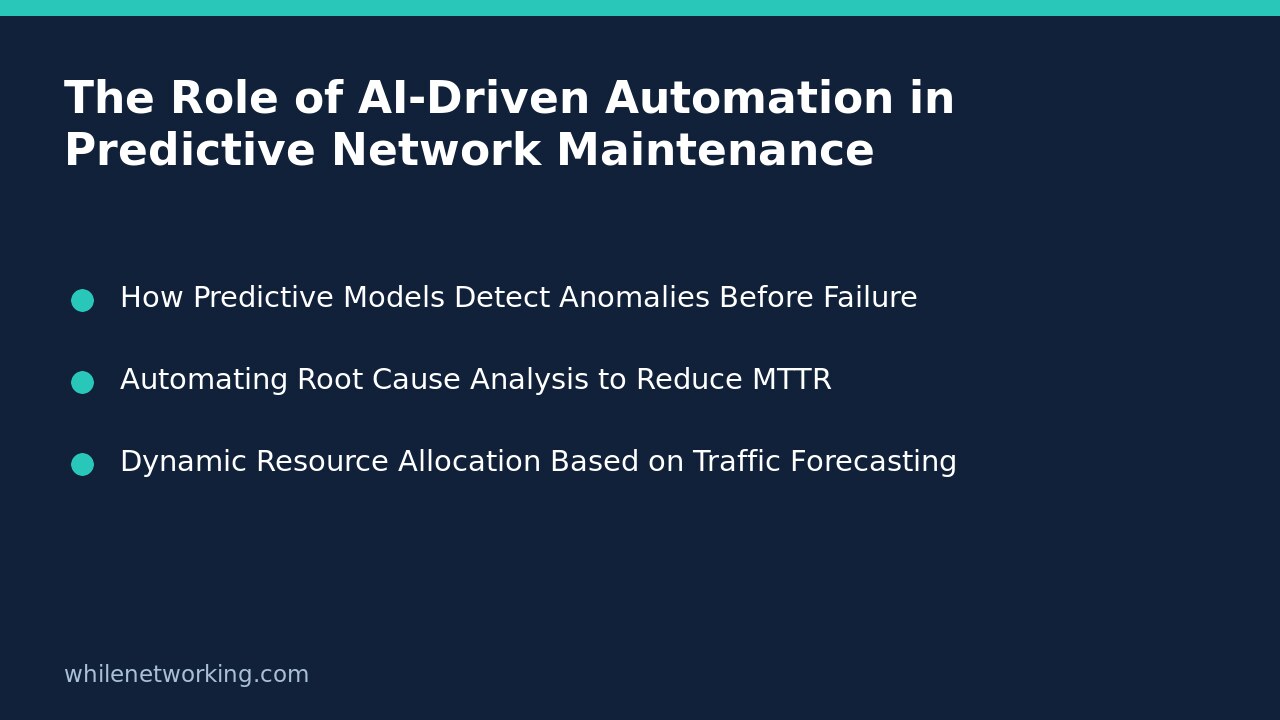
How Predictive Models Detect Anomalies Before Failure
Traditional network monitoring often relies on static thresholds, such as alerting when CPU usage exceeds 80%. However, these rules frequently generate false positives or miss slow-burning issues that operate within “normal” ranges but deviate from the baseline behavior of a healthy system. AI-driven models, particularly those utilizing unsupervised learning, do not rely on pre-defined limits. Instead, they learn the unique behavioral fingerprint of every device in the network.
These algorithms continuously ingest data from NetFlow logs, SNMP traps, and vendor-specific telemetry APIs. By applying statistical analysis and anomaly detection techniques, the system identifies deviations that human operators might overlook. For instance, a storage array might show normal read/write speeds but exhibit a slight increase in latency during off-peak hours—a pattern that could indicate a failing drive or an impending firmware bug. The AI flags this as a high-probability risk event, triggering an automated investigation before the drive physically fails and causes data loss.
Automating Root Cause Analysis to Reduce MTTR
One of the most significant challenges in network maintenance is Mean Time to Resolution (MTTR). When an incident occurs, engineers must sift through logs from dozens of devices to determine the root cause. AI automation accelerates this process by automating root cause analysis (RCA). When an anomaly is detected, the system can instantly cross-reference the event with recent configuration changes, known vulnerability databases, and historical failure patterns.
This capability transforms troubleshooting from a manual detective story into a streamlined diagnostic workflow. If a specific switch port begins dropping packets, the automated system can immediately check for environmental factors like temperature spikes or power supply fluctuations in that rack. It can also verify if a recent firmware update introduced a bug affecting that hardware generation. By isolating the root cause automatically, the system provides engineers with a clear path to resolution, drastically reducing the time required to restore services.
Dynamic Resource Allocation Based on Traffic Forecasting
Predictive maintenance is not solely about preventing hardware failure; it also extends to optimizing network performance through dynamic resource allocation. AI models can forecast traffic surges based on seasonal trends, marketing campaigns, or even local events. For example, a retail chain might predict a spike in bandwidth usage during the holiday shopping season.
Armed with these predictions, automation scripts can proactively adjust Quality of Service (QoS) policies, provision additional bandwidth in specific regions, or scale cloud resources before users experience congestion. This proactive scaling ensures that the network remains resilient under load without requiring manual intervention. Furthermore, the system can identify inefficient routing paths and suggest or implement adjustments to balance load across redundant links, ensuring optimal performance even as traffic patterns evolve dynamically throughout the day.
Security Integration: Identifying Threats in Real-Time
The line between predictive maintenance and cybersecurity has blurred significantly. Network anomalies that indicate a hardware failure often share characteristics with those indicating a cyberattack. An AI-driven automation platform can distinguish between legitimate traffic spikes caused by a DDoS attack and normal business fluctuations.
By integrating security telemetry into the predictive model, the system can detect lateral movement or unusual data exfiltration patterns that mimic hardware stress signals. If an automated script detects a device behaving erratically due to malware infection rather than mechanical wear, it can isolate the affected node from the network automatically. This containment strategy prevents the spread of ransomware or other threats while simultaneously flagging the incident as a maintenance priority for the security team.
Implementation Challenges and Best Practices
Adopting AI-driven automation requires careful planning to avoid disrupting existing operations. A common mistake is attempting to deploy these systems without adequate historical data. Machine learning models require a substantial dataset to train effectively; feeding them only weeks of data will result in inaccurate predictions. Organizations should aim to collect at least six months of clean, normalized telemetry data before initiating the training phase.
Another critical consideration is the “black box” problem. Engineers need to understand why the AI made a specific recommendation. Transparency tools that explain the reasoning behind an alert—such as highlighting which variables contributed most to the prediction—are essential for gaining trust within IT operations teams. Additionally, human oversight must remain in the loop. While automation can handle routine adjustments and initial diagnostics, complex decisions involving hardware replacement or major architectural changes should always be reviewed by senior engineers to prevent costly errors.
Real-World Application: The Manufacturing Floor Scenario
Consider a large manufacturing facility utilizing Industry 4.0 technologies with thousands of connected sensors on the assembly line. Historically, this facility experienced unexpected downtime when vibration sensors indicated motor wear, but by the time the alert was acknowledged, the equipment had already failed during production hours.
By implementing AI-driven predictive maintenance, the facility connected their SCADA systems to a machine learning platform. The system began analyzing vibration frequency, heat signatures, and current draw patterns. Three months into operation, the AI detected a micro-trend in the vibration data of a critical CNC machine that correlated with a bearing fatigue pattern observed in similar units elsewhere. The system automatically generated a work order for maintenance scheduled during the next planned shutdown window, well before catastrophic failure occurred. This proactive approach saved the facility thousands of dollars in lost production time and prevented damage to the final product batch.
Conclusion
The integration of AI-driven automation into predictive network maintenance is no longer a futuristic concept but an operational necessity for modern enterprises. By shifting from reactive repairs to proactive prevention, organizations can achieve unprecedented levels of reliability and efficiency. While challenges regarding data quality and model interpretability exist, the benefits of reduced downtime, optimized resource usage, and enhanced security far outweigh the implementation costs. As networks become more complex, the only viable strategy is to embrace intelligent automation that learns, adapts, and protects the digital infrastructure that powers the business.