
Traditional IT infrastructure has long been defined by the “on-premises” model: companies purchased physical servers, built dedicated data centers, and spent significant capital on cooling, power, and security hardware. This approach offered total control but came with rigid scalability, high upfront costs, and a constant struggle to keep pace with emerging technologies. Cloud computing has fundamentally disrupted this status quo, shifting the paradigm from capital expenditure (CapEx) to operational expenditure (OpEx) and transforming how organizations manage data, applications, and security. By moving workloads to shared environments managed by third-party providers, businesses can achieve unprecedented agility, reduce total cost of ownership, and focus on innovation rather than maintenance. This transformation is not merely a technical upgrade; it is a strategic realignment that enables companies to respond instantly to market changes, support remote workforces, and leverage advanced analytics without the heavy lifting of hardware procurement.
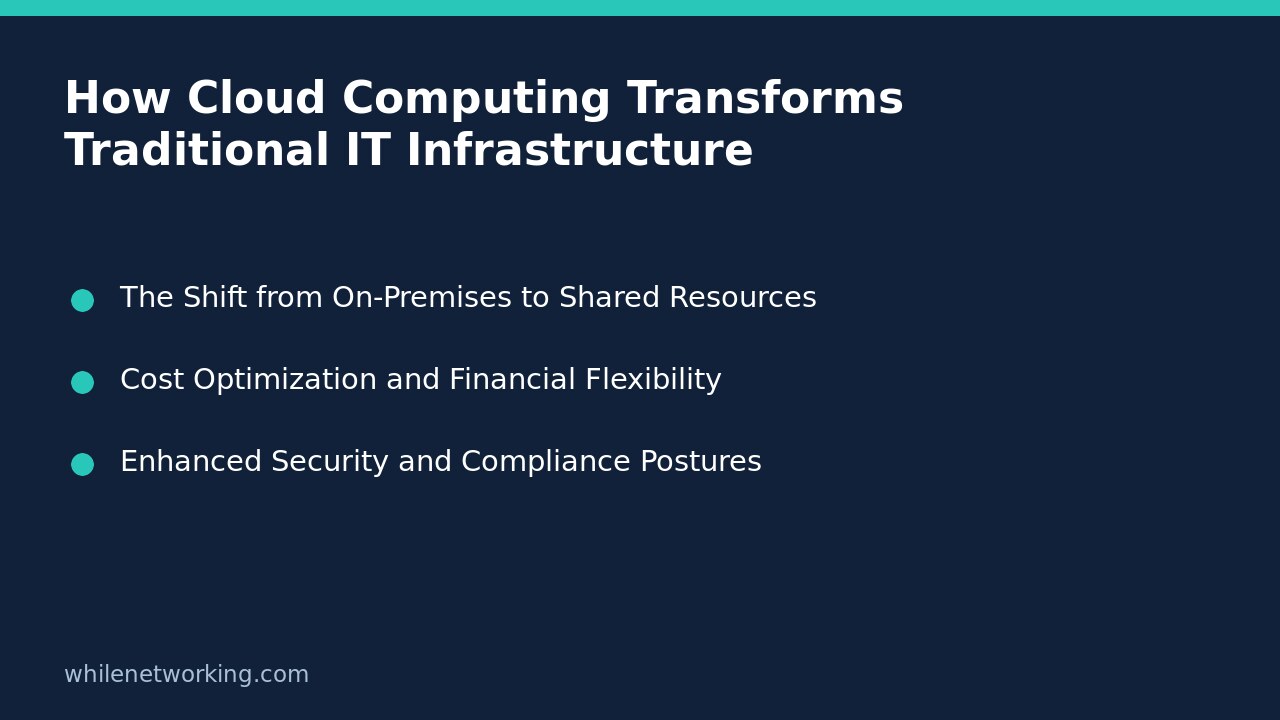
The Shift from On-Premises to Shared Resources
At the core of this transformation is the fundamental change in resource ownership and management. In a traditional setup, an IT team must predict future growth years in advance, buying servers that may sit idle for months or become obsolete before they are fully utilized. Cloud computing introduces the concept of elastic scalability. Instead of owning the hardware, organizations rent computing power on a pay-as-you-go basis. This means if traffic spikes during a holiday sale or a product launch, the infrastructure automatically expands to meet demand and contracts when usage drops.
This shift eliminates the risk of over-provisioning. Consider a retail company that historically needed to install new server racks every six months to handle Black Friday traffic. With cloud architecture, they can spin up additional instances instantly during peak hours and shut them down immediately after. This dynamic capability ensures resources are always matched exactly to demand, optimizing costs and performance simultaneously. The result is an infrastructure that breathes alongside the business rather than constraining it with static limitations.
Cost Optimization and Financial Flexibility
One of the most immediate impacts of cloud adoption is the restructuring of financial models for IT spending. Traditional data centers require massive upfront investments in hardware, networking equipment, and facility upgrades. These costs are sunk; if a server fails or becomes obsolete, the investment is largely lost. Cloud computing converts these heavy capital expenditures into predictable operational expenses. Companies only pay for the compute, storage, and bandwidth they actually use.
Furthermore, this model extends to maintenance and support. In a traditional environment, an organization bears the full brunt of hardware failures, firmware updates, and security patching for their entire data center. Cloud providers absorb these costs and responsibilities, offering enterprise-grade reliability that would be prohibitively expensive for most businesses to replicate internally. For example, a mid-sized financial firm might spend millions on redundant power systems and backup generators. By migrating to the cloud, they inherit a global network of redundant facilities managed by experts, effectively transferring risk away from their balance sheet.
Enhanced Security and Compliance Postures
Contrary to the misconception that moving to the cloud reduces security, it often enhances an organization’s defensive posture. Major cloud providers invest billions annually in security research, threat intelligence, and physical security measures that far exceed what any single company could afford on its own. They adhere to rigorous international compliance standards such as GDPR, HIPAA, and SOC 2, providing a robust framework for regulatory adherence.
However, this transformation requires a shift in mindset regarding responsibility. In the traditional model, the IT team managed everything from the physical floor tiles up to the operating system. In the cloud, security is often described using the “Shared Responsibility Model.” The provider secures the infrastructure (hardware, network, hypervisor), while the customer secures their data, identity management, and application configuration. This forces organizations to adopt a more mature approach to cybersecurity, focusing on zero-trust architectures, encryption of data at rest and in transit, and rigorous access controls. Misconfigurations remain a primary risk, but the tools available for detection and remediation are far superior to legacy solutions.
Accelerating Innovation and Time-to-Market
The rigidity of traditional hardware procurement creates a bottleneck for innovation. It can take months or even years to procure, install, and configure new servers to test a new software stack or deploy an artificial intelligence model. Cloud computing removes these barriers entirely. Developers can provision environments in minutes, experiment with different technologies like Kubernetes or serverless architectures, and tear them down just as quickly if the project fails.
This speed translates directly into faster time-to-market for products and services. Startups can compete with industry giants by leveraging the same advanced tools without building a massive engineering team first. Large enterprises can pivot their digital strategies rapidly, adopting microservices or containerization to modernize legacy applications without replacing the underlying hardware. The ability to iterate quickly allows companies to gather user feedback, refine features, and release updates continuously, staying ahead of customer expectations in an increasingly digital marketplace.
Real-World Example: A Manufacturing Firm’s Digital Transformation
To illustrate the tangible benefits, consider a global manufacturing company with factories across three continents. Historically, they relied on isolated on-premises servers for each location to monitor production lines and manage inventory. This resulted in data silos, inconsistent reporting, and an inability to perform real-time predictive maintenance.
By migrating to a hybrid cloud architecture, the firm connected their factory floor sensors directly to the cloud via secure industrial internet protocols. They deployed a unified analytics platform that aggregated data from all locations into a single dashboard. Within weeks, they implemented machine learning models to predict equipment failures before they occurred, reducing downtime by 25%. Inventory optimization algorithms adjusted supply orders in real-time based on actual production rates and shipping delays, cutting logistics costs significantly. The firm did not need to replace their physical machinery; they simply changed the intelligence layer running above it. This case demonstrates that cloud transformation is about enhancing existing assets with digital capabilities, not necessarily scrapping everything old.
Strategic Considerations for Migration
While the benefits are clear, transforming traditional infrastructure requires careful planning. Organizations must conduct a thorough assessment of their current workloads to determine which applications are suitable for migration. Not every legacy application runs well in the cloud; some may require refactoring or remain on-premises via hybrid models. Security policies must be redefined to match the shared responsibility model, and teams need training to manage cloud-native operations. Additionally, data sovereignty laws vary by region; organizations must ensure their cloud architecture complies with local regulations regarding where customer data is stored and processed. A successful transformation is not a “lift and shift” but a strategic redesign of IT processes to align with cloud capabilities.
Conclusion
The transformation from traditional IT infrastructure to cloud computing represents more than a technological upgrade; it is a strategic evolution that reshapes how businesses operate, innovate, and compete. By embracing the flexibility, cost efficiency, and security strengths of the cloud, organizations can break free from the constraints of physical hardware and focus on their core missions. As digital disruption accelerates, those who adapt their infrastructure to be agile and scalable will find themselves better positioned to navigate uncertainty and seize new opportunities in a rapidly changing global economy.