
In the modern digital landscape, understanding how data moves between your on-premise infrastructure and remote cloud environments is no longer optional; it is a strategic imperative. For beginners navigating the transition from traditional networking to cloud architectures, grasping connectivity models is the first critical step toward building resilient, scalable, and secure systems. This guide demystifies the primary ways organizations connect to the cloud, explaining the mechanics of each model, their respective trade-offs, and when to deploy them. By the end of this article, you will have a clear framework for selecting the right connectivity strategy for your specific business needs.
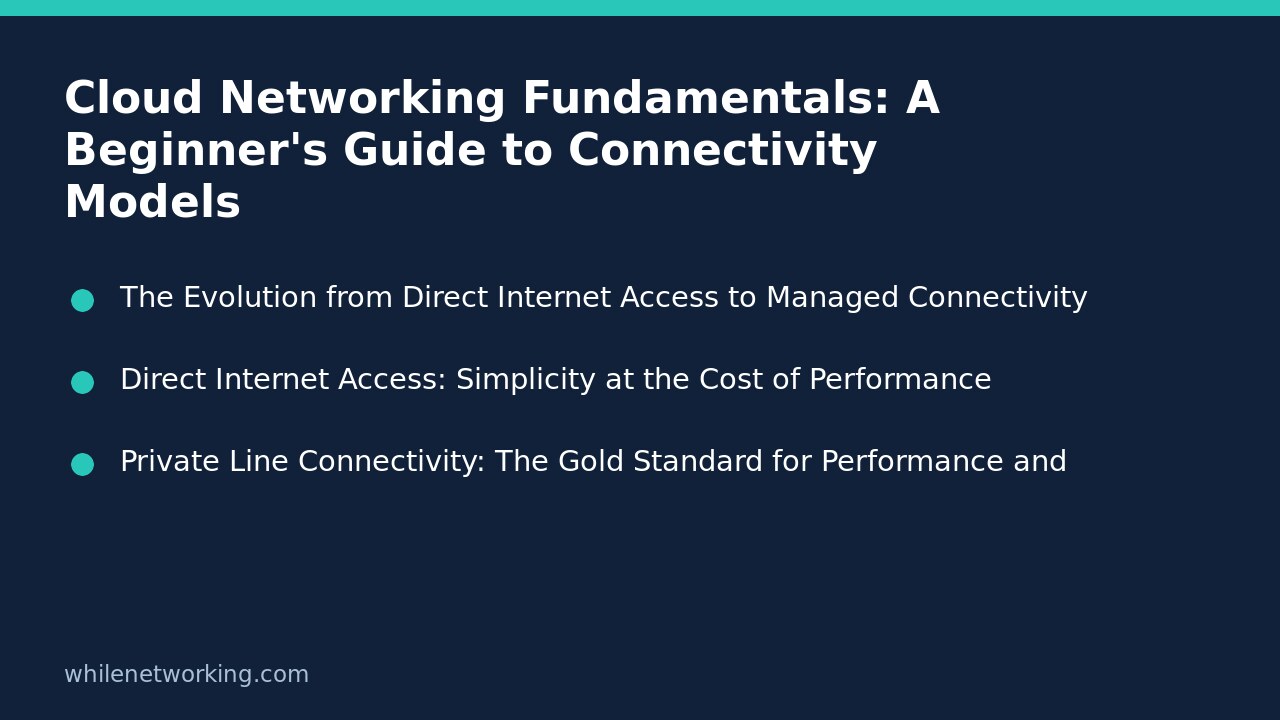
The Evolution from Direct Internet Access to Managed Connectivity
Historically, businesses relied on direct internet connections to access cloud services like email or file storage. While simple, this approach often resulted in unpredictable latency, security vulnerabilities, and lack of control over data traffic. As applications became more complex, requiring low-latency interactions for databases and virtual desktops, the industry shifted toward managed connectivity models. These models provide a dedicated pathway between your local network and the cloud provider’s edge, ensuring consistent performance and enhanced security posture. The three dominant models are Direct Internet Access (DIA), Private Line Connectivity, and Hybrid Cloud Networking, each serving distinct architectural requirements.
Direct Internet Access: Simplicity at the Cost of Performance
Direct Internet Access represents the most straightforward connectivity model. In this setup, traffic flows directly from your on-premise servers or workstations to the public internet to reach cloud resources. This method requires no additional hardware beyond standard routers and firewalls and involves minimal configuration costs. It is ideal for non-critical applications such as web browsing, SaaS email clients, or public-facing websites where occasional latency spikes are acceptable.
However, DIA comes with significant limitations. Because it shares bandwidth with other internet traffic, performance can degrade during peak usage times. Furthermore, routing all sensitive data through the public internet increases exposure to potential interception or malicious attacks unless robust encryption and security policies are strictly enforced. For beginners, starting with DIA is a valid low-cost entry point, but organizations should plan to migrate critical workloads away from this model as their reliability requirements grow.
Private Line Connectivity: The Gold Standard for Performance and Security
Private Line Connectivity, often implemented via MPLS (Multiprotocol Label Switching) or dedicated fiber optic links, offers a dedicated circuit between your data center and the cloud provider’s edge. This model provides guaranteed bandwidth, low latency, and strict Quality of Service (QoS) guarantees. Unlike DIA, traffic does not traverse the public internet, significantly reducing the attack surface and ensuring that sensitive data remains on a private network path.
Major cloud providers offer specific services to facilitate this, such as AWS Direct Connect or Azure ExpressRoute. These services allow you to establish a physical connection that links your premises directly to the provider’s backbone. The primary advantage is stability; once established, the connection speed and availability are contractually guaranteed. This makes Private Line Connectivity the preferred choice for mission-critical applications like real-time video conferencing, high-frequency trading platforms, or large-scale database replication where even milliseconds of delay can impact operations.
Virtual Private Networks: Bridging Gaps with Encryption
Virtual Private Network (VPN) technology serves as a flexible bridge between on-premise networks and the cloud. While early VPN implementations relied on public internet tunnels that could be slow and insecure, modern software-defined wide area networking (SD-WAN) has revolutionized this space. A site-to-site VPN encrypts traffic over the public internet, creating a secure tunnel that appears as a private extension of your local network within the cloud environment.
This model is particularly useful for organizations that cannot justify the cost of dedicated physical lines or who need to connect multiple remote offices to a central cloud hub dynamically. The trade-off involves some latency due to encryption/decryption overhead and potential congestion on public internet routes, though SD-WAN technologies have largely mitigated these issues through intelligent path selection. For small to medium-sized businesses, a well-configured VPN remains a cost-effective solution for secure remote access without the capital expenditure of private lines.
Hybrid Cloud Networking: Orchestrating Multiple Environments
Hybrid cloud networking is not a single technology but an architectural strategy that integrates public and private clouds while maintaining seamless connectivity. In this model, organizations leverage the scalability of public cloud services (like AWS or Azure) for burstable workloads while keeping sensitive data in a private on-premise data center connected via Private Line or VPN. The challenge lies in managing the complexity of routing tables, security policies, and identity management across these disparate environments.
Successful hybrid networking requires a unified view of your network topology. Tools like AWS Transit Gateway or Azure Virtual WAN act as central routers, simplifying the connection of multiple VPCs (Virtual Private Clouds) to on-premise networks. This approach allows for cost optimization by running steady-state applications on-premise and scaling out to the cloud during peak demand, all while maintaining a consistent security perimeter.
Real-World Scenario: Choosing the Right Model for an E-Commerce Startup
Consider an e-commerce startup launching its website. Initially, the company uses Direct Internet Access to host their public-facing web server and use SaaS tools for customer support. As traffic grows, they experience latency during traffic spikes, causing slow page loads that hurt conversion rates. To address this, they implement a hybrid model: they establish a Private Line connection to host their primary database on-premise for high-speed read/write operations, while using the public cloud for scalable web server instances during holiday sales events. They secure the link between their two environments with encrypted tunnels managed by an SD-WAN controller. This evolution demonstrates how connectivity models should scale alongside business needs, balancing cost, performance, and security dynamically.
Checklist for Evaluating Your Connectivity Needs
Before committing to a specific connectivity model, evaluate your infrastructure against these criteria:
* Latency Sensitivity: Does your application require sub-millisecond response times? If yes, prioritize Private Line.
* Budget Constraints: Can you afford the monthly cost of dedicated circuits, or is a shared internet connection sufficient for now?
* Security Requirements: Is data encryption and isolation mandatory due to compliance regulations (e.g., GDPR, HIPAA)?
* Scalability Needs: Will your bandwidth requirements fluctuate significantly, favoring a hybrid approach?
* Management Complexity: Do you have the staff expertise to manage complex routing tables, or do you need managed services like AWS Direct Connect?
Conclusion: Building a Resilient Future
Selecting the right cloud connectivity model is a foundational decision that impacts your organization’s agility and security. While Direct Internet Access offers simplicity, Private Line Connectivity delivers the performance required for modern enterprise applications, and Hybrid Cloud Networking provides the flexibility to balance cost and scale. There is no one-size-fits-all solution; the best approach often involves a combination of these models tailored to specific workload requirements. As you advance your cloud journey, remember that connectivity is not just about getting data from point A to point B; it is about doing so securely, efficiently, and reliably in an increasingly interconnected world.