
Automated access control systems have evolved from simple magnetic stripe readers into sophisticated networks utilizing facial recognition, gait analysis, and behavioral biometrics. While these technologies offer enhanced security and seamless user experiences, they introduce significant ethical challenges, particularly regarding algorithmic bias. When Artificial Intelligence (AI) models are trained on non-representative datasets, they can inadvertently deny access to protected groups or flag legitimate users as threats based on demographic characteristics. Implementing robust ethical AI frameworks is no longer optional for enterprise security teams; it is a critical component of risk management and regulatory compliance. This article explores the structural and procedural measures necessary to mitigate bias in automated access control, ensuring that security enhancements do not come at the cost of equity or inclusion.
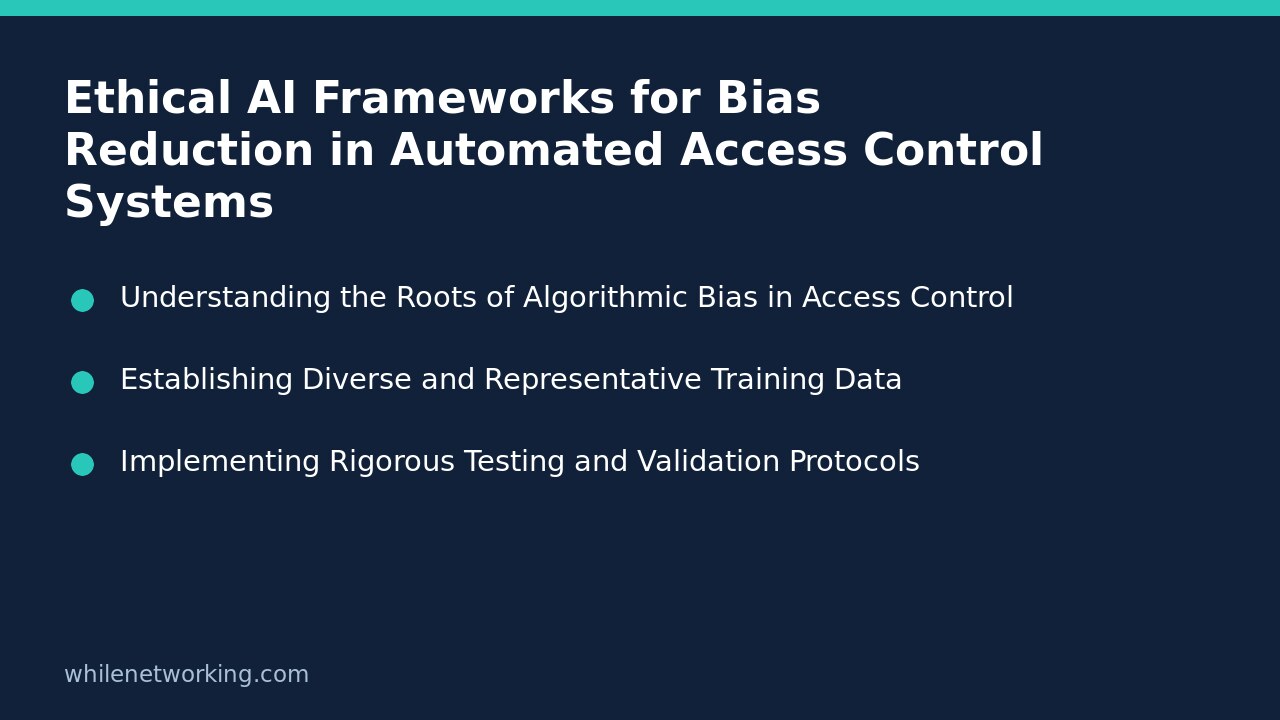
Understanding the Roots of Algorithmic Bias in Access Control
To effectively reduce bias, one must first understand where it originates in the context of physical and digital access systems. The primary driver of algorithmic bias is dataset imbalance. If an AI model is trained predominantly on images of individuals with lighter skin tones, it will inevitably struggle to accurately identify or authenticate users with darker complexions. This phenomenon is not a result of the algorithm’s “intent” but rather a mathematical consequence of the training data distribution.
Furthermore, bias can emerge from label errors. In historical datasets used for facial recognition, mislabeling certain demographics as “non-compliant” or “suspicious” can teach the system to associate those demographic traits with security threats. Another source of bias is context dependency; a model trained in an urban environment with diverse foot traffic may perform poorly when deployed in a controlled corporate setting with a specific demographic profile, leading to false positives or negatives that disproportionately affect minority groups. Ignoring these root causes leads to systems that create new forms of discrimination under the guise of automation.
Establishing Diverse and Representative Training Data
The most effective technical intervention against bias is the curation of high-quality, representative training data. Organizations must move beyond convenience sampling and actively seek datasets that reflect the demographic diversity of their actual user base. This includes ensuring representation across various skin tones, ages, genders, ethnicities, and even variations in lighting conditions and accessories like glasses or headwear.
When procuring third-party datasets for model training, security teams must audit the vendor’s documentation for diversity reports. If a dataset lacks sufficient representation of specific groups, the organization should either supplement it with custom-collected data—ensuring strict privacy compliance—or utilize transfer learning techniques that allow the model to adapt to new demographic data without retraining from scratch. Continuous data auditing is essential; as the user base changes over time, the training data must be updated to prevent “model drift,” where the system’s performance degrades for emerging demographics.
Implementing Rigorous Testing and Validation Protocols
Validation cannot be a one-time event before deployment; it must be an ongoing process integrated into the software development lifecycle (SDLC). Standard accuracy metrics, such as overall error rates, are often misleading because they mask disparities between groups. Instead, organizations must calculate disaggregated performance metrics, breaking down false positive and false negative rates by demographic category.
For example, a system might claim 99% accuracy overall, but if the false rejection rate (Type I error) is 10% for one demographic group and 1% for another, the system is inherently biased. Security teams should employ “adversarial testing,” where engineers intentionally try to trick the AI with edge cases specific to underrepresented groups to identify vulnerabilities before they impact real users. Regular red-teaming exercises focused on bias can help uncover these blind spots early in the development phase.
Developing Transparent Governance and Accountability Structures
Technical solutions must be supported by strong governance frameworks. Organizations should establish an internal Ethics Board or AI Review Committee comprising members from diverse backgrounds, including non-technical stakeholders such as HR representatives, legal counsel, and community advocates. This group is responsible for reviewing new access control algorithms before deployment to assess potential ethical risks.
Transparency is also key to accountability. When an automated system denies access, the user should receive a clear explanation that the decision was made by an AI system, along with information on how to appeal the decision. Maintaining detailed logs of access attempts and AI decision logic (within privacy bounds) allows for post-incident analysis. If a bias incident occurs, these logs provide the forensic evidence needed to understand what happened and how to correct the model. Without clear accountability structures, organizations risk normalizing discriminatory outcomes simply because “the machine decided so.”
Mitigating Real-World Consequences Through Human-in-the-Loop Systems
No AI system should operate entirely autonomously in high-stakes environments like corporate headquarters or secure facilities without human oversight. A “human-in-the-loop” (HITL) approach ensures that a security officer can intervene when the AI’s confidence score is low or when a denial seems anomalous based on contextual knowledge.
In practice, this means configuring access control systems to flag low-confidence authentication attempts for manual review rather than automatically denying entry. This pause prevents immediate negative experiences for users who might be legitimate but are misidentified due to lighting changes, camera angles, or minor demographic mismatches in the training set. Over time, data from these manual reviews can be fed back into the training pipeline to refine the model, creating a virtuous cycle of improvement that continuously reduces bias while maintaining security standards.
Real-World Example: The Multi-Vendor Validation Challenge
Consider a multinational corporation implementing a new facial recognition system across its global offices. During pilot testing, the internal team noticed that employees from South Asian backgrounds were experiencing higher false rejection rates compared to their Caucasian counterparts. Instead of ignoring this as a minor glitch, the IT security team initiated an investigation. They discovered that the initial training dataset was heavily skewed toward North American demographics and indoor lighting conditions typical of that region.
The solution involved a multi-step remediation process:
1. Data Augmentation: The team collected thousands of new images specifically featuring employees from underrepresented groups in various lighting scenarios.
2. Model Retraining: They retrained the model using this balanced dataset, focusing on minimizing the disparity in error rates between groups rather than just maximizing overall accuracy.
3. Threshold Adjustment: They adjusted the authentication threshold for low-confidence matches to require higher certainty before denying access, effectively reducing false negatives for specific demographics without significantly increasing security risk.
4. Governance Review: An ethics committee reviewed the new system metrics and approved the deployment only after confirming that error rates were within a defined equity margin across all groups.
This example illustrates that bias reduction is an iterative engineering and governance process, not a single checkbox item. It requires active monitoring, willingness to invest in diverse data, and a commitment to human oversight. As AI continues to integrate deeper into physical security infrastructure, adhering to these ethical frameworks will define the difference between a secure facility and an inclusive one.
Disclaimer: The information provided in this article is for educational and informational purposes only. It does not constitute legal, financial, or professional security advice. Specific implementation details, data privacy laws (such as GDPR or CCPA), and regulatory requirements vary by jurisdiction and change over time. Organizations should consult with qualified legal counsel and cybersecurity professionals before implementing automated access control systems.