
Linux Network Troubleshooting Commands is a practical skill for IT professionals managing Linux servers, web applications, cloud instances and internal infrastructure. This tutorial is written for readers who already know basic commands and want a more useful, real-world workflow.
- Real-world server administration context
- Step-by-step troubleshooting approach
- Useful Linux commands and examples
- Security and operational best practices
Why Linux network troubleshooting matters
Linux servers often host web applications, APIs, databases, DNS services, containers and monitoring tools. When connectivity fails, you need a structured command-line workflow instead of random guessing.
Start with interface and IP checks
Use ip addr and ip route to confirm the server has the correct IP address, subnet, gateway and routing table. Many outages are caused by incorrect interface, gateway or DNS configuration.
Check listening ports with ss
The ss command helps confirm whether a service is listening on the expected port. For example, if Nginx is not listening on port 80 or 443, the problem is probably local service configuration rather than the network.
Test DNS and routes
Use dig or nslookup for DNS resolution and traceroute to inspect the network path. Separate DNS failures from routing failures before escalating.
Recommended workflow
Check IP configuration, confirm the service is listening, test local firewall rules, test DNS resolution, test external connectivity, then review logs.
Useful Linux commands
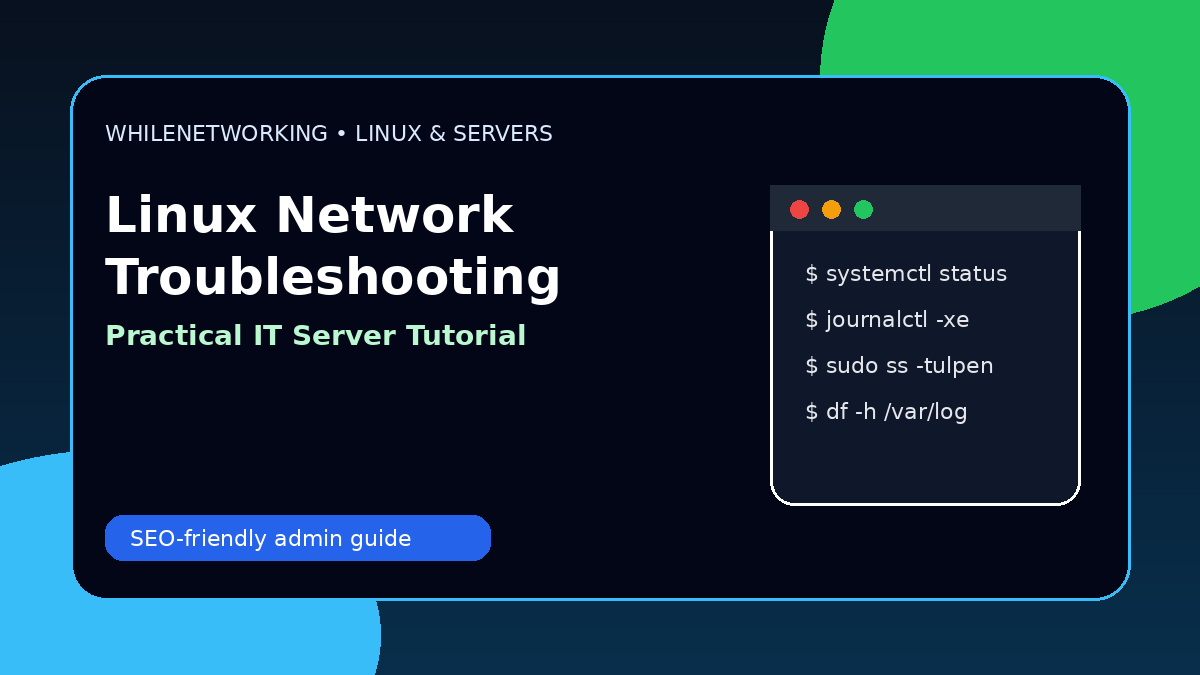
ip addr show
ip route
ss -tulpen
ping -c 4 8.8.8.8
dig example.com
traceroute example.com
journalctl -xe
Best-practice checklist
- Test changes in a lab or staging server first.
- Take backups before editing important configuration files.
- Document commands, config paths and service changes.
- Monitor logs after restarting or reloading services.
- Use least privilege and avoid unnecessary root sessions.
Final thoughts
Linux administration improves with practice and a repeatable process. Save the commands, build a small lab and test each workflow before using it on production servers.
Educational note: This tutorial is for learning purposes. Always test carefully and avoid applying changes to production systems without approval, backups and a rollback plan.