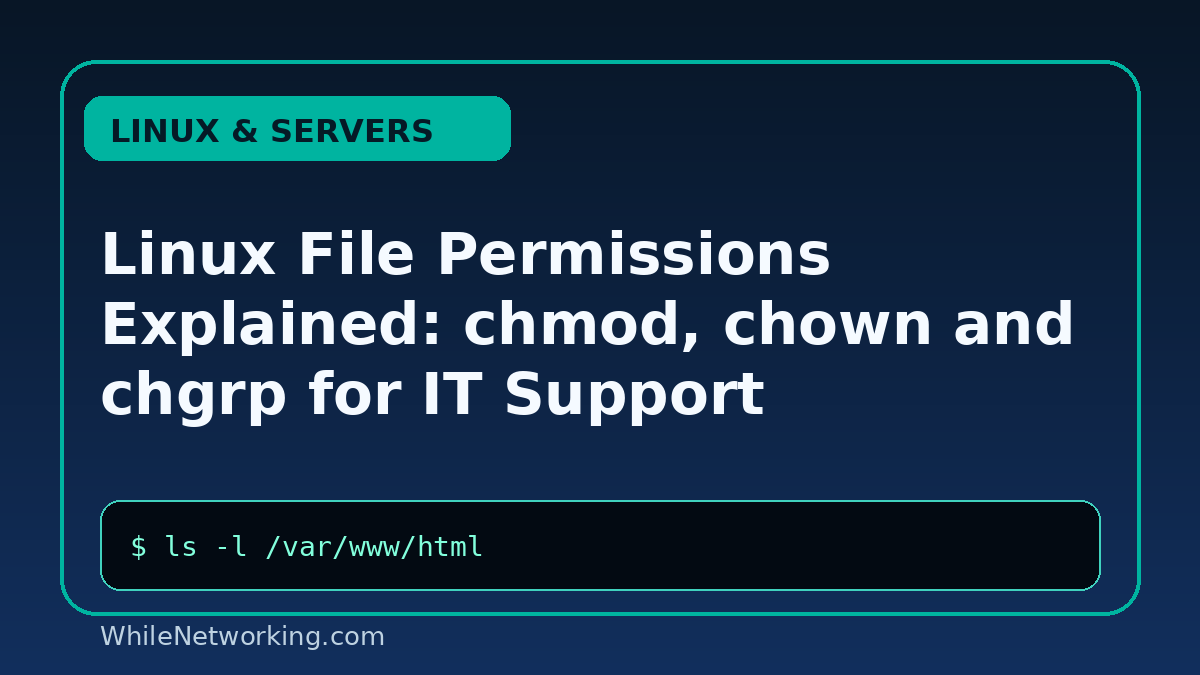

Learn how Linux file permissions work and how to safely use chmod, chown and chgrp in real support tasks. This guide is written for IT support engineers, system administrators, help desk staff and learners who want practical Linux server skills.
What you will learn
- How to read rwx permissions
- Owner, group and others
- Safe chmod examples
- Changing file owner and group
- Troubleshooting permission denied errors
How to read rwx permissions
Linux permissions show who can read, write or execute a file. In output from ls -l, the first permission block describes the owner, group and everyone else. Understanding this line helps you solve many “permission denied” tickets quickly.
Owner, group and others
Every file belongs to one user and one group. The owner usually controls the file, the group allows team access, and others means everyone else on the system. Good administration keeps access as narrow as possible.
Safe chmod examples
Use chmod carefully because a small permission change can expose sensitive files or break applications. Prefer specific modes such as 640 or 750 instead of opening everything with 777.
Changing file owner and group
Use chown and chgrp when files are owned by the wrong user or service account. This is common after copying web files, restoring backups or moving application folders.
Troubleshooting permission denied errors
Check the file permission, parent directory permission, ownership and the user running the service. Many errors come from the directory path rather than the final file itself.
Useful commands
Run commands carefully and test on a lab machine before using them on production servers.
ls -l /var/www/htmlchmod 640 report.txtchmod 750 scripts/chown www-data:www-data index.htmlchgrp developers shared-folder/
Practical troubleshooting workflow
- Confirm the exact symptom and error message.
- Check the service, file, user or network state with read-only commands first.
- Make one small change at a time and record what changed.
- Verify the result from the user or application point of view.
- Document the fix so the same issue is easier next time.
Common mistakes to avoid
- Do not copy commands blindly from the internet into a production server.
- Do not use broad permissions or root access when a smaller change is enough.
- Always keep a backup or rollback plan before changing system settings.
FAQ
Is this suitable for beginners?
Yes. The examples are beginner friendly but still useful for real IT support and server administration work.
Can I use these commands on Ubuntu, Debian or CentOS?
Most commands work across common Linux distributions. Package names, log paths or service names can vary slightly.
Should I test before using these steps on production?
Yes. Always test carefully in a lab or maintenance window, especially when changing permissions, services, users, firewall rules or scheduled jobs.
Disclaimer: This tutorial is for educational purposes. Test commands carefully. WhileNetworking is not responsible for misuse, damage, data loss or production issues.