
The convergence of network automation and Zero Trust (ZT) architectures represents a paradigm shift in cybersecurity, moving from static, perimeter-based defenses to dynamic, identity-centric models. While this integration promises enhanced agility and reduced human error, it introduces complex security implications that organizations must navigate carefully. The core challenge lies in balancing the speed of automated provisioning with the rigorous verification required by Zero Trust principles. If automation logic is flawed or lacks sufficient contextual awareness, it can inadvertently create wide-open pathways for attackers. Conversely, a well-implemented system uses automation to continuously verify and enforce least-privilege access, effectively shrinking the attack surface in real-time.
Understanding these implications requires dissecting how automated policy engines interact with Zero Trust components like identity providers, device health checks, and micro-segmentation tools. The primary risk is “automation drift,” where scripts or configuration management tools inadvertently grant excessive permissions due to a lack of current context about user behavior or threat intelligence. In a traditional network, a misconfigured firewall rule might be caught during a quarterly review; in an automated Zero Trust environment, that same error could be propagated instantly across thousands of micro-segments before detection. Therefore, the security posture is only as strong as the integrity of the automation pipeline itself.
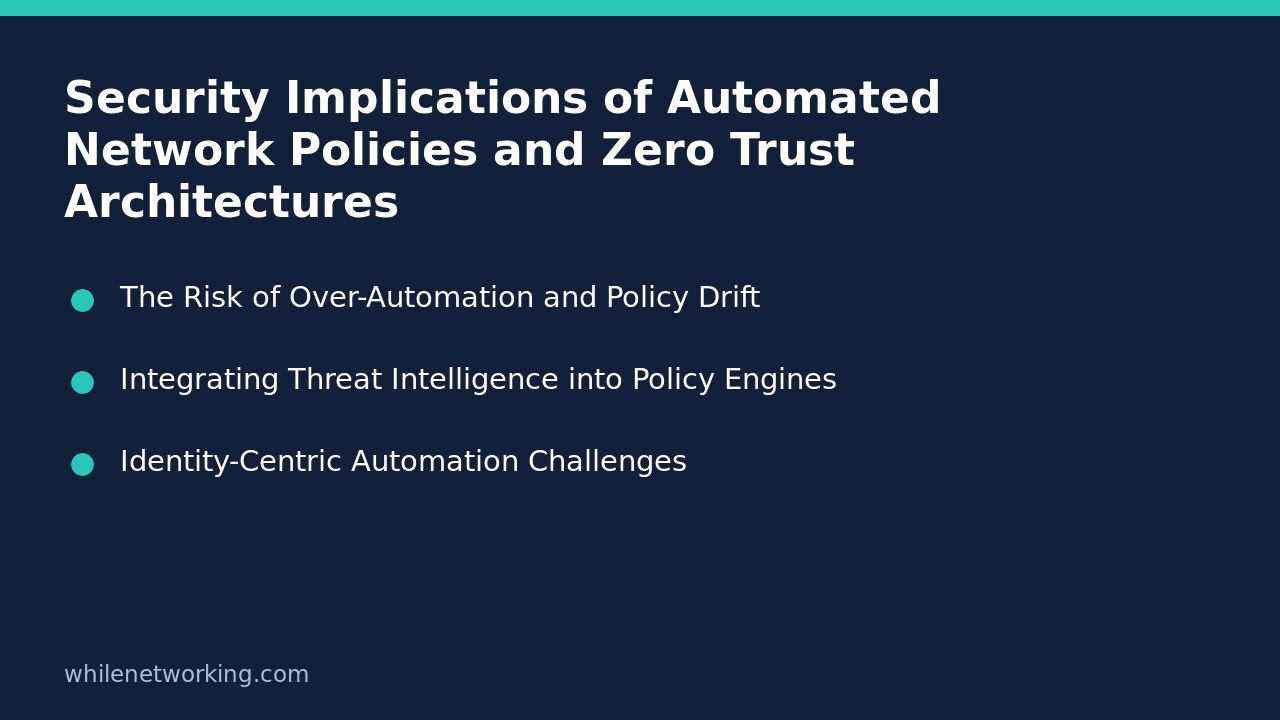
The Risk of Over-Automation and Policy Drift
One of the most significant security implications is the potential for policy drift caused by unchecked automation. In a Zero Trust architecture, access decisions are made constantly based on multiple trust factors: who the user is, where they are, what device they use, and the sensitivity of the data. Automation tools that manage these policies must have real-time access to these dynamic variables. If an automated script assumes a static IP address or a standard user role without verifying current context, it may generate overly permissive policies.
For example, consider an automation tool designed to grant temporary access to a developer for debugging purposes. If the script fails to verify that the specific endpoint is still healthy or if the developer’s credentials have been compromised in a separate incident, the tool might renew or extend that access token automatically. This “trust by default” behavior contradicts the Zero Trust mandate of “never trust, always verify.” The implication is that automation can become an enabler for lateral movement if not strictly bound by immutable verification steps.
Integrating Threat Intelligence into Policy Engines
A critical component of securing automated policies within a Zero Trust framework is the seamless integration of real-time threat intelligence. Static policies cannot defend against modern threats that evolve hourly; therefore, automation must ingest data from external feeds and internal telemetry to dynamically adjust access rules. However, this introduces a new vector for compromise: poisoned data feeds.
If an attacker compromises the source of threat intelligence or injects false positives into the feed, automated policy engines could react inappropriately. They might block legitimate traffic based on false flags, causing operational downtime, or conversely, they might open ports to trusted-but-compromised entities if the threat feed incorrectly identifies them as safe. The security implication here is that the automation layer becomes a single point of failure for data integrity. Organizations must implement redundant data sources and validation layers within their policy engines to ensure that no single compromised feed can dictate network access rules.
Identity-Centric Automation Challenges
Zero Trust places identity at the center of security, meaning that automated policies must be deeply tied to identity providers (IdP). Automation tools often struggle with the complexity of managing ephemeral identities and short-lived credentials. For instance, when a service-to-service communication is established via an automated provisioning workflow, the system must ensure that the generated certificate or token is immediately bound to specific resource constraints.
The security implication arises when automation handles identity lifecycle events too aggressively. If an administrator account is deactivated but an automation job scheduled for later that day has already queued up a high-privilege access request based on the old profile, the system might execute that request before realizing the user is no longer valid. To mitigate this, organizations must implement “eventual consistency” checks with tight timeout windows and ensure that automation workflows are idempotent, meaning they can be run multiple times without causing unintended side effects or granting duplicate privileges.
Micro-Segmentation and the Complexity of Scale
Automated network policies are often used to enforce micro-segmentation, isolating workloads into granular security zones. While this limits blast radius in case of a breach, automating the creation of thousands of these segments creates a complexity challenge. The sheer volume of rules can lead to performance degradation in the policy enforcement points, such as software-defined networking (SDN) controllers or next-generation firewalls.
Furthermore, automated scaling of micro-segments can inadvertently isolate critical services if the automation logic does not account for application dependencies. For example, an automated routine might quarantine a server that shows signs of infection but fails to whitelist the necessary internal traffic required for replication or backup processes, effectively locking down data recovery efforts. The security implication is that scale without intelligent context awareness can lead to availability issues that mimic outages, complicating incident response during active attacks.
Real-World Implementation Checklist
To navigate these complexities, organizations should adopt a rigorous checklist when deploying automated policies in a Zero Trust environment:
- Validate Data Sources: Ensure all threat intelligence feeds and identity sources are authenticated and cross-referenced with at least one secondary source before influencing policy changes.
- Implement Human-in-the-Loop (HITL) Gates: For high-risk policy changes, such as opening new egress paths or granting admin-level access to production systems, require explicit human approval even if triggered by automation scripts.
- Audit Automation Logic Regularly: Treat automation code like infrastructure-as-code; version control and peer review of scripts that modify network policies are mandatory.
- Monitor for Drift: Deploy continuous monitoring tools that compare actual policy states against the intended “golden configuration” to detect unauthorized changes immediately.
- Test Failure Modes: Conduct regular chaos engineering exercises where threat feeds are simulated as poisoned or offline to observe how the automation engine reacts and whether it defaults to a secure posture (deny-by-default).
Conclusion
The security implications of combining automated network policies with Zero Trust architectures are profound. While automation offers the speed necessary to adapt to modern threats, it demands an equally sophisticated layer of oversight to prevent policy drift, data poisoning, and over-permissioning. The transition is not merely a technical upgrade but a cultural shift toward viewing automation as a potential risk vector that must be managed with the same rigor as any other security control. By integrating robust verification mechanisms, diverse threat intelligence sources, and strict governance over automation logic, organizations can harness the benefits of Zero Trust without compromising their security posture. The goal is to create a system where automation acts as a multiplier for human intent, ensuring that every access decision is both swift and secure.