
Network operations centers (NOCs) are increasingly drowning in volume. Legacy ticketing systems often rely on rigid, keyword-based categorization that fails to capture the nuance of human communication. When a technician submits a ticket stating, “The login page is throwing a 500 error,” or when an end-user reports, “I can’t access my dashboard,” traditional parsing logic may miss the underlying connection between these disparate phrases. Natural Language Processing (NLP) offers a transformative solution by enabling systems to understand context, sentiment, and semantic meaning rather than just matching strings of text. By integrating NLP into network ticket resolution workflows, organizations can automate triage, suggest accurate root causes, and accelerate mean time to resolution (MTTR).
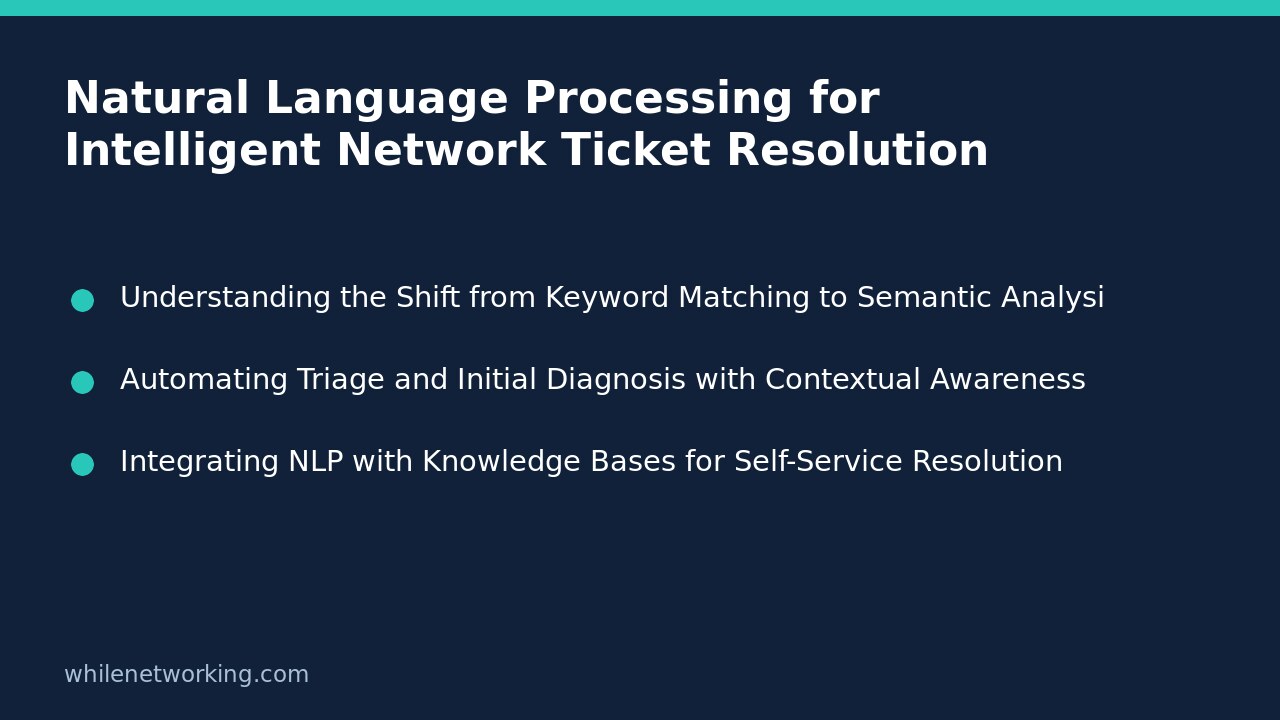
Understanding the Shift from Keyword Matching to Semantic Analysis
Traditional automated ticketing systems operate on a “bag of words” model. If a user types “server down,” the system looks for those exact tokens. However, network issues are rarely described with perfect consistency. Users might say “the server is unreachable,” “connection refused,” or “ping timeout.” In these scenarios, semantic analysis becomes critical. NLP models analyze the relationship between words and the intent behind the message.
For instance, an NLP engine can recognize that “unreachable” and “timeout” share a high probability of indicating network connectivity issues, even if the specific vocabulary differs. This capability allows for intelligent routing where tickets are automatically categorized not just by what is broken, but by how it is being described. This reduces the friction between user reporting and technical categorization, ensuring that complex issues are routed to the correct specialized team without manual intervention.
Automating Triage and Initial Diagnosis with Contextual Awareness
One of the most significant applications of NLP in network management is automated triage. When a ticket enters the system, an NLP-driven agent can instantly scan the description for key entities such as IP addresses, device names, error codes, and specific symptoms. Unlike simple regex patterns, modern NLP models can handle unstructured data effectively.
Consider a scenario where a user reports: “The printer in the marketing department won’t print color documents anymore.” A basic system might flag this as a generic “printer issue.” An NLP-enabled system, however, extracts the specific constraints: location (marketing), function (printing), and symptom (color vs. black & white). It can then cross-reference this with known incidents or configuration changes. If a recent firmware update affected color drivers on that specific subnet, the system can immediately suggest a fix or route the ticket to the print services team rather than general IT support. This contextual awareness drastically reduces the back-and-forth emails between users and technicians.
Integrating NLP with Knowledge Bases for Self-Service Resolution
Intelligent ticket resolution extends beyond routing; it involves providing the right answer at the right time. NLP allows organizations to build dynamic, conversational knowledge bases that understand user queries in natural language. Instead of forcing users or agents to search through a linear list of articles tagged with specific keywords, an NLP interface acts like a knowledgeable peer.
If an agent asks, “How do I reset the VLAN on switch port 24?”, the NLP engine parses the intent and retrieves relevant documentation, CLI commands, or video tutorials from the knowledge base. It can even summarize long technical manuals into concise steps based on the specific error code mentioned in the ticket header. This integration empowers junior engineers to resolve Level 1 and Level 2 tickets faster by providing immediate, context-aware guidance derived from historical successful resolutions stored in the system’s vector database.
Handling Unstructured Data from Logs and User Feedback
Network devices generate massive amounts of unstructured data, including logs, emails, chat transcripts, and social media mentions regarding outages. Traditional analytics struggle with this volume of text data. NLP tools excel here by performing entity recognition and sentiment analysis on these streams.
For example, during a widespread outage, users might post in internal forums saying, “The whole building is offline.” Simultaneously, logs from the core router might show a BGP flapping event. An NLP pipeline can ingest both sources, correlate the sentiment of the user complaints with the technical severity of the logs, and automatically escalate the ticket to senior management. This holistic view ensures that high-impact issues are prioritized based on both technical metrics and user impact, creating a more responsive operational model.
Real-World Implementation: The Smart Triage Workflow
To illustrate how NLP transforms ticket resolution, consider a mid-sized enterprise implementing a new workflow. Previously, their average ticket resolution time was 48 hours due to misclassification. After deploying an NLP layer trained on historical ticket data and device logs, they observed the following changes:
- Ingestion: A user submits a ticket via email or portal describing intermittent Wi-Fi drops in the conference room.
- Extraction: The NLP model identifies entities: “Wi-Fi,” “intermittent,” “conference room.” It detects the sentiment as “frustrated” but not “critical emergency.”
- Correlation: The system checks the network topology and correlates with recent AP firmware updates in that specific floor zone.
- Action: Instead of waiting for a technician, the system suggests a reboot command to the specific Access Point or flags it as a potential known issue requiring a patch.
- Resolution: If the suggested action fails, the ticket is automatically enriched with the NLP-derived summary and routed to the wireless engineering team with a pre-filled diagnosis note.
This workflow reduced their average resolution time from 48 hours to under 6 hours for similar issues, demonstrating the tangible ROI of semantic understanding in network operations.
Best Practices and Considerations for Deployment
Implementing NLP for ticket resolution requires careful planning to avoid common pitfalls. First, data privacy must be paramount. Ensure that any NLP processing happens within a secure environment or uses anonymized datasets before feeding information into external models. Second, do not rely solely on out-of-the-box models; fine-tune them with your organization’s specific jargon and error codes. Generic models may misunderstand internal slang or proprietary device names.
Additionally, maintain a human-in-the-loop approach. While NLP can handle 80% of routine cases, complex network anomalies require human intuition. Build feedback mechanisms where agents can correct the NLP model when it misclassifies a ticket. Over time, this creates a self-improving system that adapts to evolving network threats and user behaviors. Finally, monitor for “hallucinations” or over-confidence errors where the AI suggests fixes without sufficient data backing, ensuring that safety checks remain active before any automated remediation scripts are executed.
Conclusion
Natural Language Processing represents a pivotal evolution in how organizations manage network infrastructure. By moving beyond rigid keyword matching to deep semantic understanding, NLP transforms passive ticketing systems into active intelligence engines. It bridges the gap between human language and technical reality, enabling faster triage, smarter knowledge retrieval, and more efficient resource allocation. As networks become more complex and distributed, the ability to interpret unstructured data will be just as critical as managing the hardware itself. Organizations that adopt these technologies today will find themselves better positioned to handle future challenges, turning the noise of daily operations into actionable insights.