
In the high-stakes environment of modern networking, unplanned hardware failures are often the most disruptive event a network engineer can face. A sudden outage on a core router or a switch stack can halt business operations before a single ticket is even logged. Traditionally, network maintenance has relied on two reactive strategies: preventive maintenance based on fixed schedules (replacing gear regardless of its actual condition) and corrective maintenance (fixing issues only after they occur). Both approaches have significant drawbacks; scheduled replacement wastes budget on healthy equipment, while reactive fixes lead to downtime and lost productivity. Predictive maintenance represents a paradigm shift in this space. By leveraging Artificial Intelligence (AI) and Machine Learning (ML), network operators can analyze vast streams of telemetry data to anticipate hardware failures before they happen, allowing for proactive intervention that minimizes downtime and optimizes capital expenditure.
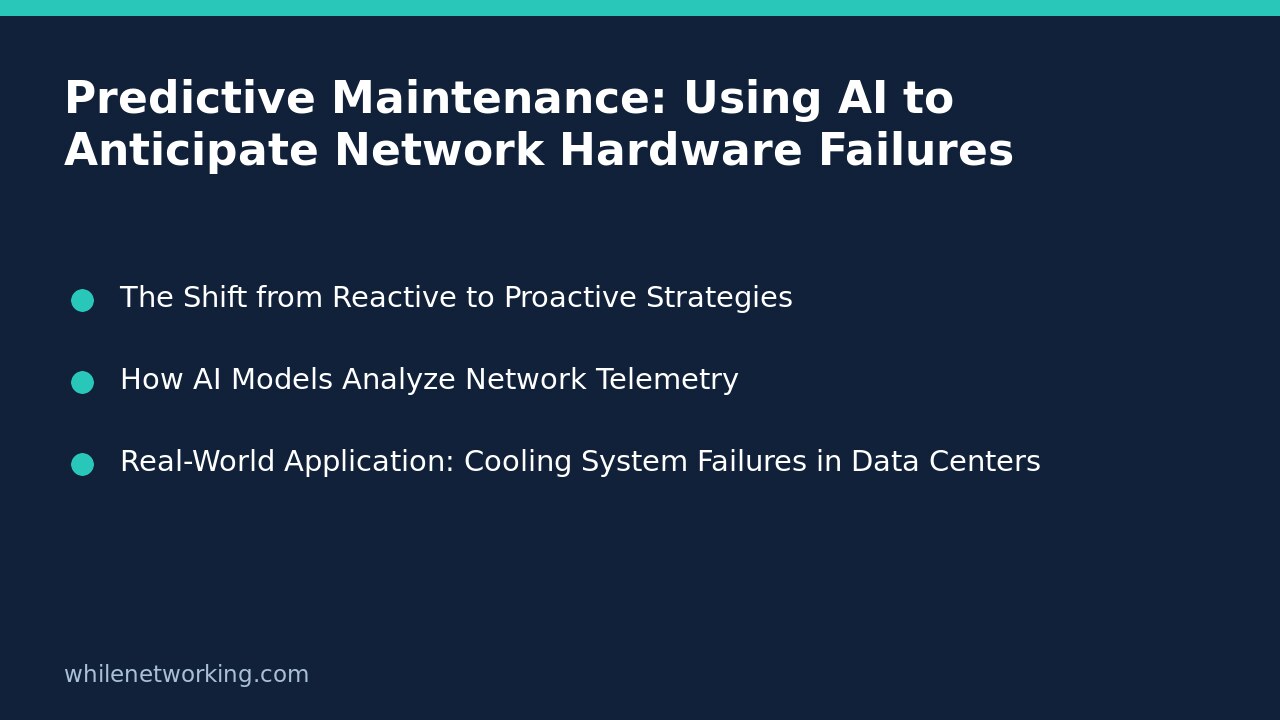
The Shift from Reactive to Proactive Strategies
To understand the value of AI in this context, one must first recognize the limitations of traditional monitoring. Legacy systems often trigger alerts only when a device crosses a specific threshold, such as CPU usage hitting 90% or an interface going down. By the time these alerts fire, the problem may already be impacting performance or causing instability. Furthermore, simple threshold-based monitoring fails to capture the nuanced degradation patterns that precede hardware death. For instance, a fan might spin slower than usual for weeks before failing completely, or a power supply might exhibit slight voltage irregularities that are invisible to standard dashboards but indicative of impending failure.
AI transforms raw data into actionable intelligence. Machine learning models ingest historical telemetry, including temperature logs, voltage readings, error counters, and fan speeds, alongside external factors like environmental conditions in the data center. These models identify non-linear patterns and correlations that human analysts might miss. Instead of asking “Is this device broken?”, AI asks “How likely is this device to break in the next 48 hours?” This probabilistic approach enables a true proactive stance, shifting IT operations from an emergency response mode to a managed risk environment.
How AI Models Analyze Network Telemetry
The core mechanism behind predictive maintenance lies in the analysis of continuous data streams. Modern network infrastructure generates terabytes of telemetry every hour. AI algorithms, particularly those utilizing deep learning and anomaly detection, process this data to build a baseline of “normal” behavior for every piece of hardware.
When a device deviates from its established baseline, the system flags it for review. For example, an optical transceiver might show a gradual increase in bit error rates (BER) that correlates with rising ambient temperatures in a specific rack. An ML model trained on similar historical data could recognize this pattern as a precursor to laser degradation or overheating components. The AI does not just detect the anomaly; it often predicts the Remaining Useful Life (RUL) of the component. This allows administrators to plan replacements during scheduled maintenance windows rather than scrambling for emergency parts and technician time.
Real-World Application: Cooling System Failures in Data Centers
A compelling real-world example of predictive maintenance involves environmental sensors within data centers, specifically those monitoring cooling infrastructure. While routers and switches are critical, the cooling systems that keep them running are equally vital. A common failure mode is a clogged filter or a failing compressor in a Precision Air Conditioning (PAC) unit.
In a traditional setup, an admin might notice that server racks adjacent to a specific PAC unit are starting to throttle performance due to heat accumulation. However, by the time this happens, the cooling unit may have already failed. With AI-driven predictive maintenance, the system analyzes airflow velocity data, temperature differentials across the rack, and compressor vibration sensors continuously. The AI might detect that a specific PAC unit is working slightly harder than its peers to maintain the same temperature setpoint, indicating reduced efficiency due to dust buildup or mechanical wear.
The system could generate an alert predicting a total failure of that unit within the next three weeks. This gives facilities managers ample time to order parts and schedule a maintenance window. If ignored, the predicted failure would likely coincide with a heatwave or a period of high compute load, causing widespread server throttling or hardware damage. The AI intervention saves not just the cooling unit, but potentially thousands of dollars in server repairs and hours of downtime.
Common Mistakes in Implementing Predictive Maintenance
Despite its benefits, implementing predictive maintenance comes with pitfalls that organizations must avoid. A primary mistake is treating all data as equally valuable. Feeding a machine learning model with noisy, unfiltered logs can degrade its accuracy. It is crucial to curate high-quality datasets, ensuring that telemetry sources are reliable and timestamps are synchronized across the network. Another common error is over-reliance on vendor-specific dashboards without integrating them into a unified observability platform. Siloed data prevents the AI from seeing the holistic picture of how a switch failure might impact the broader fabric.
Furthermore, there is the risk of alert fatigue. If the AI model is not tuned correctly, it may generate false positives—predicting failures that never occur. This erodes trust in the system, causing engineers to ignore legitimate warnings. To mitigate this, organizations must establish a feedback loop where predicted outcomes are validated against actual events, allowing the models to retrain and improve their precision over time. Finally, ignoring the “long tail” of older hardware is a mistake; legacy devices often behave differently than modern ones, requiring specific training data to ensure the AI understands their unique failure signatures.
Strategic Benefits for Network Operations Teams
The adoption of AI-driven predictive maintenance yields tangible strategic benefits beyond simple uptime. First, it optimizes the supply chain. Instead of holding massive inventories of spare parts or rushing emergency shipments, organizations can order components exactly when needed, reducing costs and storage requirements. Second, it extends the lifecycle of assets. By addressing minor issues before they escalate, operators can keep expensive hardware running longer, delaying costly capital refreshes.
Third, it enhances workforce efficiency. Network engineers spend less time troubleshooting intermittent issues that turn into major outages and more time on strategic projects like network design and security hardening. The shift from “firefighting” to “engineering” improves morale and job satisfaction within the team. Additionally, having data-backed insights simplifies compliance reporting. Regulators and auditors increasingly require proof of proactive risk management; AI logs provide a clear audit trail demonstrating that failures were anticipated and mitigated according to best practices.
Checklist for Deploying Predictive Maintenance Solutions
If you are considering implementing an AI-based predictive maintenance solution, follow this practical checklist to ensure a successful rollout:
- Audit Your Data Sources: Identify all telemetry collectors (SNMP, Syslog, NetFlow, Telemetry streams) and ensure they are exporting relevant metrics like temperature, fan speed, voltage, and error counters.
- Define Baselines: Work with your AI vendor or data science team to establish what “normal” looks like for your specific hardware models and environmental conditions. Do not rely solely on out-of-the-box vendor profiles.
- Integrate into a Unified Platform: Avoid using multiple disjointed tools. Integrate your telemetry data into a single observability platform where AI models can correlate events across different layers of the network.
- Establish a Feedback Loop: Create a process for engineers to confirm or reject AI predictions. Use this feedback to continuously retrain and refine the machine learning models.
- Plan for False Positives: Develop a protocol for investigating “false alarm” alerts without disabling the monitoring system, ensuring that trust is maintained while accuracy improves.
- Update Procurement Processes: Align your spare parts inventory management with the AI’s predicted failure rates to reduce holding costs and ensure timely availability of critical components.
Conclusion
Predictive maintenance using AI marks a significant evolution in network reliability. By moving away from rigid schedules and reactive fixes, organizations can harness the power of data to foresee hardware failures before they disrupt operations. While the technology requires careful implementation and high-quality data, the return on investment through reduced downtime, optimized spending, and extended asset life is substantial. As network complexity grows with the advent of 5G, SD-WAN, and hybrid cloud architectures, the ability to anticipate hardware issues will not just be a competitive advantage but a necessity for maintaining resilient digital infrastructure.