
The modern threat landscape has evolved from targeted attacks to high-volume, automated campaigns that overwhelm traditional signature-based defenses. Artificial Intelligence (AI) and Machine Learning (ML) are no longer optional luxuries; they are essential components of a resilient cybersecurity posture. By integrating these technologies strategically, organizations can shift from reactive firefighting to proactive threat hunting. This guide outlines practical strategies for embedding AI into network security operations, focusing on detection, response, and infrastructure management while addressing the nuances of implementation.
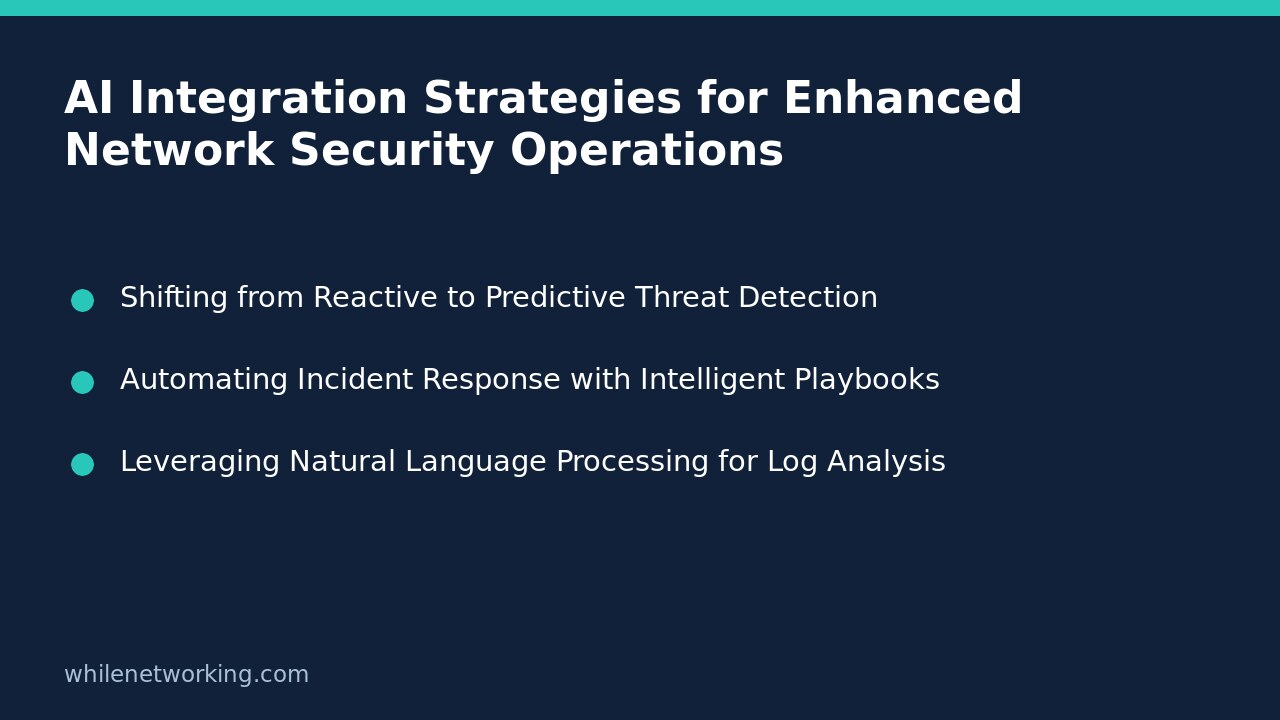
Shifting from Reactive to Predictive Threat Detection
Traditional firewalls and intrusion detection systems rely heavily on known signatures and static rules. They struggle to identify zero-day exploits or polymorphic malware that changes its code to evade detection. AI integration allows security operations centers (SOCs) to analyze vast datasets in real-time, identifying anomalies that deviate from established baselines.
Machine learning models can learn normal network behavior patterns—such as typical traffic volumes, user login times, and data transfer rates—and flag deviations instantly. For example, if a server usually processes 100 requests per minute but suddenly attempts to send 5,000 requests to an external IP address, an AI model can identify this as a potential data exfiltration attempt before human analysts notice it. This capability is crucial for detecting insider threats and compromised credentials that often slip past conventional checks.
Automating Incident Response with Intelligent Playbooks
One of the most significant bottlenecks in network security is the time required to investigate and remediate alerts. Security teams are frequently overwhelmed by false positives, leading to “alert fatigue.” AI-driven automation addresses this by analyzing the context of an alert and executing predefined response actions only when confidence thresholds are met.
Intelligent playbooks can automate routine tasks such as isolating infected endpoints from the network, blocking malicious IP addresses at the firewall, or revoking compromised API keys. However, full autonomy is rarely advisable. The most effective strategy involves a “human-in-the-loop” approach where AI handles initial triage and low-risk actions, while complex decisions require analyst approval. This hybrid model ensures speed without sacrificing accuracy, reducing mean time to response (MTTR) significantly during active breaches.
Leveraging Natural Language Processing for Log Analysis
Network devices generate terabytes of logs daily in various formats, making manual review impossible. Natural Language Processing (NLP), a subset of AI, excels at unstructured data analysis. NLP tools can parse log entries from diverse sources—servers, routers, cloud consoles, and endpoint detection systems—to extract meaningful entities like user IDs, file hashes, and error codes.
By clustering these entities, AI can identify correlation patterns that humans would miss. For instance, NLP might detect that a specific sequence of login failures on a web server correlates with unusual DNS queries originating from the same subnet, suggesting a coordinated attack vector. This synthesis of disparate data points provides a holistic view of the security posture, enabling deeper forensic analysis and more accurate root cause identification.
Addressing Model Security and Adversarial Machine Learning
A common misconception is that deploying AI makes a system immune to attacks. In reality, AI models are vulnerable to adversarial attacks, where attackers deliberately craft inputs designed to mislead the model. If an attacker knows how a specific neural network classifies traffic, they can slightly perturb packet headers to make malicious traffic appear benign to the AI classifier.
Organizations must adopt a defense-in-depth strategy that includes regular adversarial testing. This involves simulating attacks against the AI models themselves to identify vulnerabilities before real adversaries exploit them. Additionally, employing ensemble methods—where multiple models vote on a decision rather than relying on a single algorithm—can increase robustness. It is also critical to maintain human oversight and traditional rule-based systems as a fallback layer, ensuring that no single point of failure compromises the entire security architecture.
Practical Implementation: A Step-by-Step Integration Checklist
Successful AI integration requires careful planning to avoid disrupting existing operations. Below is a practical checklist for organizations looking to begin their journey:
- Data Consolidation: Ensure all network logs, endpoint data, and threat intelligence feeds are aggregated into a central repository. AI models require high-quality, normalized data to function effectively.
- Baseline Establishment: Allow the system to run in “shadow mode” for 30 to 90 days. During this period, collect data without making changes to establish accurate behavioral baselines.
- Model Selection and Training: Choose open-source or vendor-provided models suited to your specific infrastructure (e.g., cloud-native vs. on-premise). Fine-tune these models using historical incident data if available.
- Human-in-the-Loop Configuration: Define clear thresholds for automated actions. Start with low-risk automations like alert enrichment and escalate to isolation or blocking only after manual validation is confirmed safe.
- Continuous Monitoring and Retraining: AI models degrade over time as network conditions change (concept drift). Schedule regular retraining cycles using new data to maintain accuracy.
Real-World Example: Detecting a Supply Chain Attack
Consider a mid-sized financial firm that integrated an AI-driven User and Entity Behavior Analytics (UEBA) solution. The system monitored login patterns for all employees and third-party vendors. One Tuesday, the AI flagged a vendor account that typically accessed the network between 9 AM and 5 PM from a specific location in Frankfurt. At 3:00 AM from a remote IP in Eastern Europe, this same account accessed sensitive payroll databases and downloaded large volumes of data.
Traditional systems would have missed this because the credentials were valid and the user role was authorized. The AI, however, recognized the anomaly in time, location, and volume simultaneously. It automatically triggered an incident response playbook that isolated the vendor’s jump host, alerted the SOC team, and preserved forensic artifacts for investigation. The firm stopped the breach before any data was permanently exfiltrated, demonstrating the tangible value of proactive AI integration.
Conclusion: Balancing Innovation with Caution
Integrating AI into network security operations offers a powerful pathway to enhanced defense capabilities, but it demands a strategic, measured approach. Organizations must prioritize data quality, maintain human oversight, and continuously test their models against evolving threats. By leveraging AI for predictive detection and automated response while remaining vigilant against adversarial tactics, businesses can build a security posture that is both agile and resilient. The goal is not to replace human expertise but to augment it, allowing security professionals to focus on high-value strategic challenges rather than getting lost in alert noise.