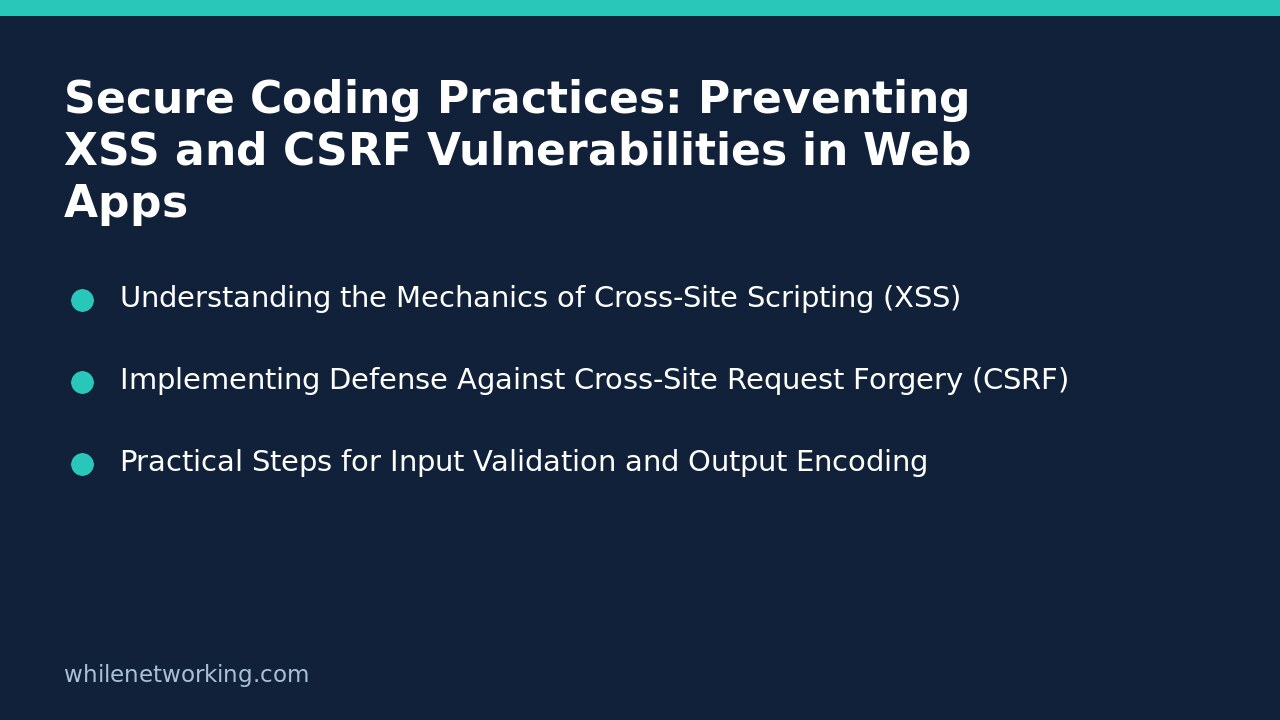

Cross-Site Scripting (XSS) and Cross-Site Request Forgery (CSRF) remain two of the most prevalent and damaging security vulnerabilities in modern web applications. Despite advancements in development frameworks, these flaws persist due to a lack of rigorous input validation and missing anti-forgery mechanisms. For developers and security engineers, understanding the distinct mechanics of these attacks is the first step toward effective prevention. XSS occurs when untrusted data is sent to an unsuspecting user’s browser and executed as code, while CSRF tricks a user into performing actions they did not intend by exploiting their authenticated session with a trusted site. Addressing both requires a layered defense strategy that combines strict input sanitization, output encoding, and the implementation of secure headers and tokens.
Understanding the Mechanics of Cross-Site Scripting (XSS)
To prevent XSS effectively, one must first distinguish between its three primary variants: reflected, stored, and DOM-based. Reflected XSS happens when malicious code is injected into a web page through user input that is immediately reflected back to the browser via an error message or search result. Stored XSS is more insidious; the attacker uploads malicious script into a database (such as a comment section or profile bio), which then executes every time another user views that content. DOM-based XSS occurs entirely on the client side, where JavaScript manipulates the Document Object Model using tainted data from URL parameters or event handlers.
The root cause of all XSS variants is the failure to separate data from code. When a web application takes user input and renders it directly into HTML without proper encoding, the browser interprets the input as executable script rather than plain text. For example, if a search bar returns results that include <script>alert(document.cookie)</script>, and the backend simply echoes this string back into an <img src="..."> tag or a paragraph, the script executes in the victim’s context. Preventing this requires consistent output encoding tailored to the context where data is rendered—whether it be inside HTML attributes, JavaScript strings, CSS styles, or URL parameters.
Implementing Defense Against Cross-Site Request Forgery (CSRF)
CSRF attacks exploit the trust a web application places in an authenticated user’s browser session. An attacker crafts a malicious request, such as a form submission or API call, that performs an action like transferring funds or changing a password. When the victim visits a site controlled by the attacker, their browser automatically includes valid cookies and authentication headers with the request to the target site. Because the request originates from a legitimate domain (like bank.com), the server processes it as if the user initiated it themselves.
The primary defense against CSRF is the use of synchronous anti-forgery tokens. Unlike XSS, which relies on script execution, CSRF relies on the browser’s automatic inclusion of credentials. By requiring a unique, unpredictable token for state-changing operations (like POST or PUT requests), developers can ensure that cross-origin requests from attacker sites will fail because those sites cannot read the token from the victim site due to Same-Origin Policy restrictions. Additionally, checking the Origin or Referer headers provides an extra layer of verification, though it should not be relied upon as the sole defense mechanism since these headers can sometimes be stripped by proxies or browsers.
Practical Steps for Input Validation and Output Encoding
The most robust way to mitigate XSS is to implement a strict input validation policy combined with output encoding. Never trust user input; assume everything coming from a client, database, or cache is malicious until proven otherwise. Use allowlists for expected input patterns rather than blocklists, which are often incomplete. For instance, if a field expects an email address, validate that it matches a strict regex pattern before storing or displaying it.
When rendering user content, apply context-specific encoding. In JavaScript contexts, escape characters like quotes and backslashes to prevent script injection. In HTML attributes, ensure special characters like &, <, >, and " are encoded appropriately. Many modern frameworks provide built-in mechanisms for this; for example, React automatically escapes props by default, but using dangerouslySetInnerHTML bypasses these protections and requires manual sanitization libraries like DOMPurify. Similarly, server-side templates in languages like Python or Java often have auto-escaping enabled, but developers must be vigilant when disabling it for dynamic content generation.
Securing HTTP Headers and Session Management
Beyond code-level fixes, configuring HTTP headers is essential for reducing the attack surface. The Content-Security-Policy (CSP) header is a powerful tool against XSS. It allows administrators to define a whitelist of trusted sources for scripts, styles, and images. By restricting script loading to specific domains or inline styles, CSP can block many XSS payloads before they even execute. For example, setting default-src 'self'; script-src 'self' ensures that only scripts hosted on the same domain are loaded, effectively neutralizing external malicious scripts injected via XSS.
Session management also plays a critical role in preventing CSRF and session hijacking. Use secure, HttpOnly, and SameSite attributes for cookies. Setting HttpOnly prevents JavaScript access to session cookies, mitigating the impact of successful XSS attacks. The SameSite=Strict or SameSite=Lax attribute instructs browsers not to send cookies with cross-site requests, significantly reducing CSRF risk. Furthermore, implement short session timeouts and require re-authentication after certain actions to limit the window of opportunity for attackers.
Real-World Example: Fixing a Vulnerable Search Feature
Consider a common scenario where a search engine displays results in a table. A vulnerable implementation might look like this:
<div id="results"></div>
<script>
  const query = document.getElementById('search-input').value;
  document.getElementById('results').innerHTML = `
    <p>You searched for: ${query}</p>
  `;
</script>
If a user searches for "><script>alert(1)</script>, the resulting HTML becomes executable. To fix this, the application must encode the output before inserting it into the DOM. Using a library like DOMPurify or manually escaping special characters ensures that the input is treated as text:
<div id="results"></div>
<script>
const query = document.getElementById('search-input').value;
const encodedQuery = query.replace(/&/g, "&")
.replace(/</g, "<")
.replace(/>/g, ">")
.replace(/"/g, """)
.replace(/'/g, "'");
document.getElementById('results').innerHTML = `
<p>You searched for: ${encodedQuery}</p>
`;
</script>
This simple change renders the malicious payload as harmless text, preventing script execution.
Common Mistakes and Final Checklist
Developers often make avoidable mistakes that lead to vulnerabilities. One common error is relying solely on Content Security Policy without implementing output encoding, assuming the header will catch everything. Another mistake is using blocklists for input validation, which attackers easily bypass by using obfuscated characters or alternative encodings. Additionally, failing to sanitize data from third-party APIs or embedded widgets can introduce supply chain vulnerabilities.
To ensure your application remains secure, follow this concise checklist:
– Validate all inputs: Enforce strict schemas and reject anything that does not match expected formats.
– Encode all outputs: Apply context-aware encoding before rendering any user-provided data in HTML, JavaScript, or CSS.
– Use anti-CSRF tokens: Include unique tokens in all state-changing forms and verify them on the server side.
– Configure CSP headers: Define strict policies to limit script sources and prevent inline execution.
– Set secure cookie attributes: Enable HttpOnly, Secure, and SameSite flags for all session cookies.
– Audit dependencies: Regularly scan third-party libraries for known vulnerabilities that could be exploited for XSS or CSRF.
By integrating these practices into your development lifecycle, you can significantly reduce the risk of XSS and CSRF attacks, ensuring a safer experience for your users.