
In the era of hyper-connectivity, network operators face an unprecedented challenge: managing systems that are exponentially more complex than those of a decade ago. Traditional root cause analysis (RCA) relies heavily on human intuition and manual correlation of logs from disparate sources—a process that is slow, error-prone, and often ineffective when dealing with distributed cloud environments or Software-Defined Networking (SDN). When a network outage occurs, seconds can translate into thousands of dollars in lost revenue. Machine Learning (ML) offers a paradigm shift by moving from reactive troubleshooting to predictive, automated diagnosis. By leveraging unsupervised learning algorithms and graph theory, organizations can now identify the true source of an issue before it cascades through the entire infrastructure, significantly reducing Mean Time to Repair (MTTR).
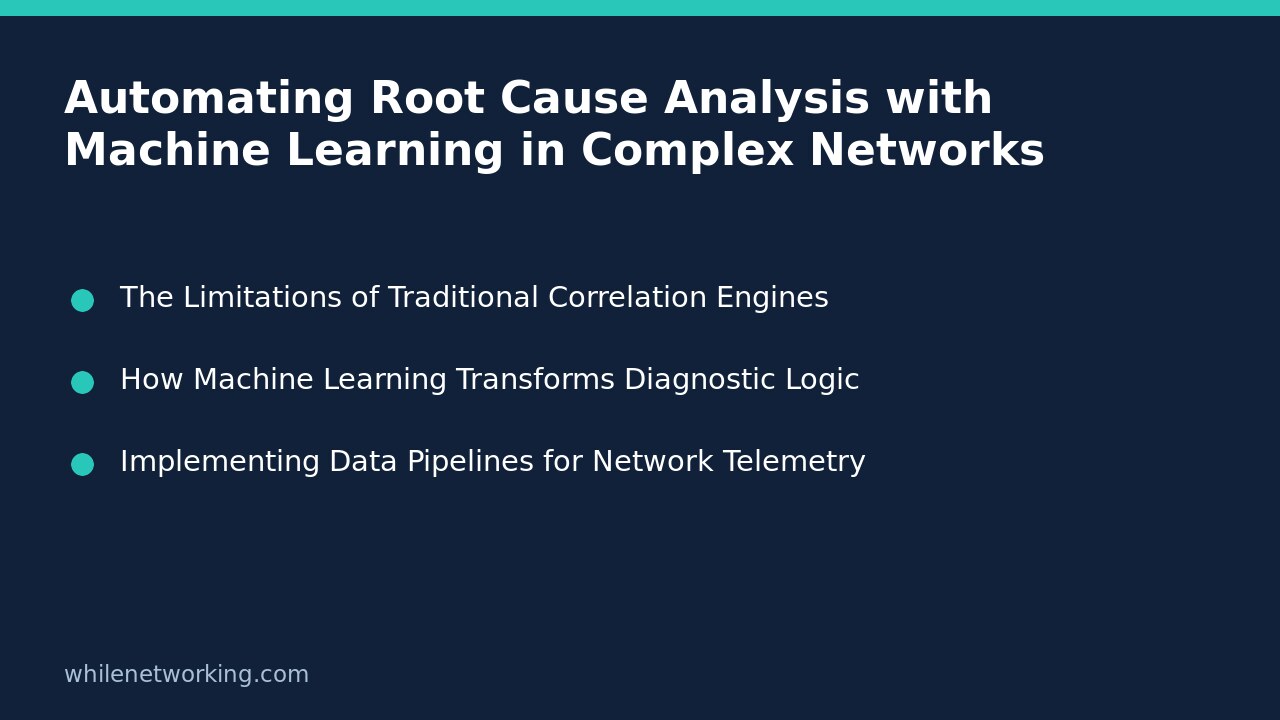
The Limitations of Traditional Correlation Engines
Historically, network management relied on rule-based correlation engines. These systems would ingest logs from routers, switches, and firewalls, looking for specific error patterns or threshold breaches. If a CPU spike matched a known pattern, the system flagged it as an anomaly. However, this approach struggles with complexity. Modern networks involve thousands of microservices, containerized applications, and dynamic IP addresses that change frequently.
Rule-based systems lack context. They cannot understand that a latency spike in Region A is likely caused by a failed database shard in Region B, nor can they distinguish between a legitimate traffic surge during a marketing campaign and a Distributed Denial of Service (DDoS) attack. Furthermore, these systems generate massive amounts of noise, alerting engineers to symptoms rather than causes. This “alert fatigue” leads analysts to ignore critical warnings, hoping the issue will resolve itself or waiting for a scheduled maintenance window that may not exist.
How Machine Learning Transforms Diagnostic Logic
Machine Learning transforms RCA by introducing statistical inference and pattern recognition capabilities that evolve over time. Unlike static rules, ML models learn from historical data to establish a baseline of “normal” network behavior. When deviations occur, the model doesn’t just flag an error; it analyzes the topology of the event to trace the propagation path.
Unsupervised learning techniques, such as clustering and anomaly detection, are particularly valuable here. These algorithms group similar traffic patterns together without prior labeling. If a new type of attack or failure mode emerges that has never been seen before, traditional systems miss it entirely. ML models, however, detect the statistical outlier immediately. Additionally, Graph Neural Networks (GNNs) allow the system to map relationships between devices. Instead of seeing a router and a server as isolated nodes, the model understands the dependency chain, allowing it to pinpoint the single point of failure that triggered a cascade of errors across multiple services.
Implementing Data Pipelines for Network Telemetry
The foundation of any successful automated RCA system is the ingestion of high-fidelity telemetry data. Modern networks generate terabytes of data daily from NetFlow, sFlow, IPFIX, and application performance monitoring (APM) tools. To make this data useful for ML, it must be normalized and stored in a scalable time-series database or a Data Lakehouse architecture.
The implementation process involves several critical steps:
1. Data Ingestion: Utilize agents or exporters to stream metrics from network devices and cloud platforms into a central repository.
2. Feature Engineering: Convert raw logs into features relevant to the model, such as packet loss rates per hop, latency percentiles (p95, p99), and connection state distributions.
3. Model Training: Train algorithms on historical data representing both normal operations and known failure scenarios. This requires labeling past incidents to create a ground truth for supervised learning.
4. Real-Time Inference: Deploy the trained models into the production environment where they continuously score incoming data streams.
It is crucial to note that data quality dictates model accuracy. If the telemetry pipeline drops packets or introduces latency, the ML model will receive incomplete information, leading to incorrect conclusions. Ensuring end-to-end visibility is a prerequisite for automation.
Addressing Security and Privacy Considerations in Automated Diagnosis
As networks become more autonomous, the risk of adversarial attacks targeting the ML models themselves increases. An attacker might attempt to “poison” the training data or send crafted traffic patterns designed to confuse the anomaly detection algorithm, causing it to miss a real outage or trigger false positives that mask an intrusion. Security teams must treat the RCA engine as a critical asset requiring its own protection layer.
Security considerations include implementing adversarial training, where models are exposed to malicious inputs during the development phase to harden their resilience. Furthermore, data privacy is paramount when analyzing network traffic. Even with aggregated metrics, certain patterns could inadvertently reveal sensitive information about internal topology or user behavior. Organizations must apply differential privacy techniques or strict access controls to ensure that automated diagnostics do not leak proprietary infrastructure details. Regular audits of the model’s decision logic are also necessary to ensure it adheres to compliance standards like GDPR or HIPAA, depending on the jurisdiction and industry.
Real-World Application: The Cloud Migration Scenario
Consider a multinational enterprise transitioning its legacy monolithic applications to a microservices architecture on AWS and Azure. During this migration, the network topology becomes highly dynamic with ephemeral instances scaling in and out based on demand. A traditional monitoring dashboard might show elevated latency across all services, leading engineers to suspect a widespread internet outage.
With an ML-driven RCA system, the scenario unfolds differently. The model detects a correlation between high latency in the “Checkout” service and a specific subnet within the database tier that is experiencing memory pressure. By analyzing the graph of dependencies, the system identifies that the “Checkout” service is calling a deprecated API endpoint hosted on a container that was recently restarted due to an OS patch, causing connection timeouts. The automated system isolates this specific container as the root cause, not the entire cloud region. It then suggests a remediation action: restarting the specific pod or rolling back the deployment of that microservice. This reduces the investigation time from hours to minutes and prevents customer-facing errors during peak transaction times.
Best Practices for Deploying Automated RCA Systems
To successfully deploy automated root cause analysis, organizations should adhere to several best practices. First, adopt a hybrid approach where ML augments human expertise rather than replacing it entirely. Engineers need to validate the model’s findings, especially in novel situations where the model might hallucinate a correlation that doesn’t exist. Second, establish a feedback loop where corrected diagnoses are fed back into the training pipeline to continuously improve model accuracy. Third, ensure explainability; if an AI recommends a fix, engineers must understand why it made that recommendation. Black-box models are risky in safety-critical infrastructure. Finally, start with pilot programs on non-critical segments of the network to tune hyperparameters and validate performance before scaling to core production environments.
Conclusion
Automating root cause analysis with machine learning represents a necessary evolution for modern IT operations. By shifting from reactive, rule-based troubleshooting to proactive, data-driven diagnosis, organizations can maintain high availability in complex, distributed environments. While challenges regarding data integration, security, and model interpretability exist, the benefits of reduced downtime and optimized resource utilization are substantial. As networks continue to grow in complexity, the integration of AI and ML will not just be an advantage but a fundamental requirement for maintaining operational resilience.