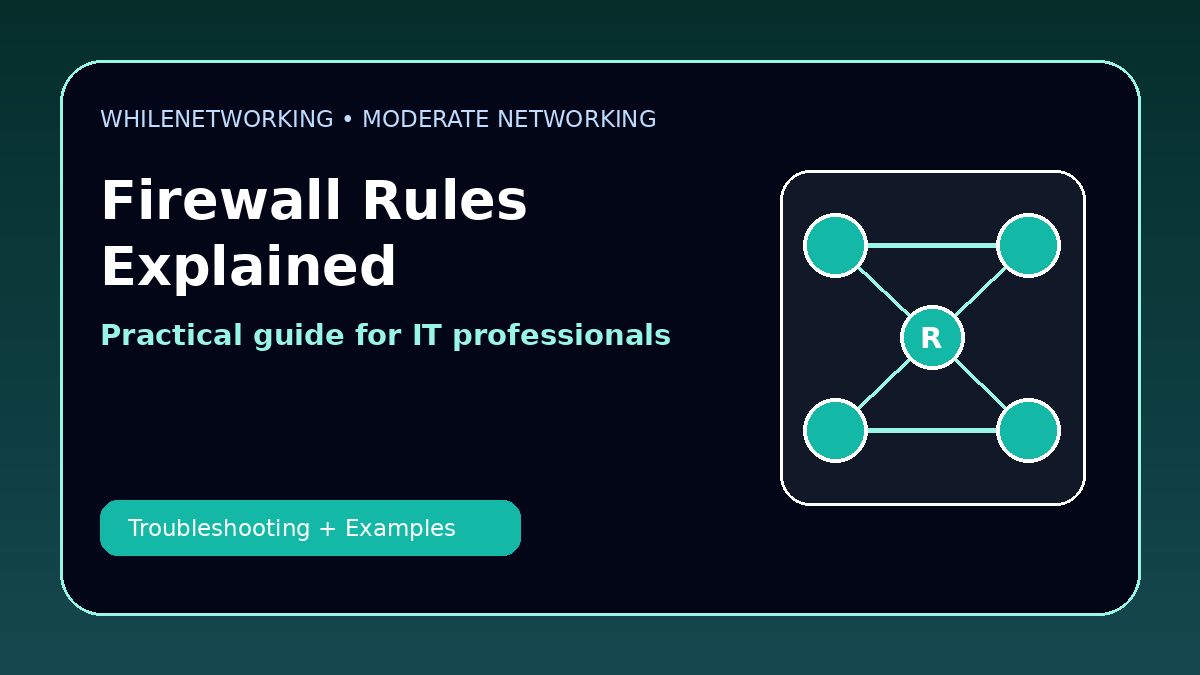

Firewall Rules Explained Inbound Outbound is a moderate-level networking topic for IT professionals who already understand basic IP addressing, DNS, routing and troubleshooting. This guide focuses on practical workplace use, common mistakes and real diagnostic steps.
- Key concept explained clearly
- Real-world troubleshooting scenarios
- Commands used by IT support and network teams
- Best practices for safe implementation
What firewall rules do
Firewall rules control whether traffic is allowed or blocked based on source, destination, protocol, port, application and user identity depending on the firewall type.
Inbound vs outbound rules
Inbound rules control traffic coming into a network or device. Outbound rules control traffic leaving a network or device. Both are important for security and troubleshooting.
Allow and deny logic
Most firewalls process rules from top to bottom. A specific allow or deny rule may match before a broader rule. Rule order is often as important as the rule itself.
Information needed before creating a rule
Collect the source IP, destination IP, port, protocol, application, business reason, duration, owner and rollback plan before changing firewall policy.
Firewall rule best practices
Use least privilege, avoid any-to-any rules, document changes, remove expired rules, log important traffic and test after implementation.
Useful commands and checks
Test-NetConnection server.example.com -Port 443
nc -vz server.example.com 443
show access-lists
show firewall policy
tcpdump -nn host 192.168.1.10 and port 443
Practical troubleshooting workflow
- Define the exact symptom and affected users.
- Confirm whether the issue is local, routing-related, security-related or application-specific.
- Collect command output before changing configuration.
- Check logs, counters and recent changes.
- Apply one change at a time and verify impact.
- Document the fix and rollback plan.
Final thoughts
Moderate networking skills are built by combining concepts with careful troubleshooting. Use these examples in a lab first, then apply the same structured approach in real environments.
Educational note: This tutorial is for learning purposes only. Test carefully and do not modify production systems without approval, documentation and backups.